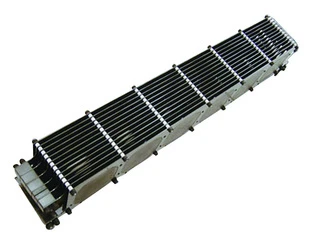
Graphite Solar Boat for Photovoltaic Wafer Processing Furnaces
Jincheng graphite solar boats carry silicon wafers and photovoltaic cells through high-temperature diffusion, coating, sintering and thermal processing furnaces, supporting delicate substrates with precision slots while maintaining clean, stable performance under repeated thermal cycling. Machined from high-purity fine-grain graphite, each boat provides controlled wafer spacing, uniform gas flow and low contamination risk essential for photovoltaic manufacturing quality.
The boat design includes precision slots or recesses that separate wafers, prevent contact damage and support consistent atmosphere circulation around each substrate. High-purity low-ash material protects silicon surfaces from contamination, while thermal shock tolerance and low expansion preserve slot geometry through repeated furnace entry and exit. Boats can be supplied for specific furnace models, wafer sizes and production capacities, with anti-oxidation treatment where loading and unloading involve air exposure.
Jincheng supplies replacement solar boats and matched wafer handling consumables for photovoltaic producers, solar cell manufacturers and furnace equipment builders, with material documentation for purity and dimensions. Each boat is inspected for slot spacing, surface quality and dimensional accuracy, and clean packaging supports high-temperature clean-process service in solar manufacturing lines.
Boat Benefits
- High-purity low-ash graphite protects silicon wafers and cell surfaces from contamination.
- Precision slots separate wafers and prevent contact damage during furnace processing.
- Controlled spacing supports uniform gas flow and consistent thermal treatment across each load.
- Thermal shock tolerance for repeated furnace entry and exit under rapid temperature change.
- Low thermal expansion preserves slot geometry and wafer fit through production cycles.
- Custom profiles for wafer size, furnace model and automated handling equipment.
- Anti-oxidation treatment extends service where boats see air exposure.
Material and Dimensional Reference
| Parameter | Standard Solar Boat | High-Purity Boat |
|---|---|---|
| Graphite Type | Fine-grain high-density | Ultra-fine high-purity isostatic |
| Bulk Density | 1.80-1.88 g/cm³ | 1.86-1.92 g/cm³ |
| Flexural Strength | 58-82 MPa | 75-95 MPa |
| Compressive Strength | 145-195 MPa | 180-220 MPa |
| Shore Hardness | 62-78 HSD | 72-84 HSD |
| Open Porosity | ≤9% | ≤6% |
| Ash Content | ≤0.05% | ≤0.02% |
| Thermal Conductivity | 85-125 W/mK | 95-140 W/mK |
| Wafer Size | 125-210 mm typical, custom | |
| Boat Length | 100-500 mm | |
| Boat Width | 80-350 mm | |
| Slot Features | Slots, recesses, support ribs, gas channels, custom nests | |
| Slot Tolerance | ±0.05 mm on slot spacing | |
| Maximum Temperature | Up to 1600-2000°C depending on process | |
Photovoltaic Process Applications
- Diffusion furnaces: Wafer boats supporting phosphorus and boron diffusion in solar cell production.
- PECVD and coating processes: Carriers for anti-reflective and thin-film coating thermal cycles.
- Electrode and metallization sintering: Boats carrying cells through firing and sintering furnaces.
- Annealing and thermal treatment: Support boats for wafer and cell annealing in photovoltaic manufacturing.
- Automated production lines: Standardized boats matched to automated loading and furnace handling systems.
- Research and specialty cells: Custom boats for novel solar cell development and small-batch processing.
Handle high-purity boats with clean gloves and dedicated tooling, verify slot dimensions and wafer fit before loading, and maintain clean assembly conditions to protect silicon surfaces. Inspect slots and support ribs after each cycle, replace boats with cracking or slot wear, and store in sealed dry packaging to prevent contamination.
Jincheng Capability
- High-purity graphite for clean photovoltaic wafer processing.
- Precision slot machining with controlled spacing and gas channels.
- Custom profiles for furnace models and automated handling equipment.
- Matched production batches for consistent solar manufacturing supply.
- Reverse engineering from existing boats and furnace drawings.
- Dimensional inspection and material purity documentation.
- Clean protective packaging for sensitive export components.
Frequently Asked Questions
Why is high purity important for solar wafer boats? Contamination from the boat can affect wafer surfaces, cell efficiency and process yield. High-purity low-ash graphite with controlled porosity reduces impurity transfer, while smooth clean surfaces help prevent particulate defects during high-temperature processing.
What causes wafer breakage in graphite boats? Breakage can result from tight or worn slots, misalignment, thermal shock, mechanical handling or inadequate support. Precision slot spacing, proper loading practice and regular inspection of boat geometry help protect delicate wafers through furnace cycles.
Can boats be designed for automated wafer loading? Yes. Overall dimensions, slot positions and handling features can be engineered to match automated loading and furnace systems, with matched batches produced to consistent dimensions for reliable production handling.
How long do solar boats last in production? Service life depends on furnace temperature, atmosphere, handling and cleaning practice, measured in cycles rather than fixed time. Slot wear, cracking, erosion and contamination risk are typical replacement indicators, and we can recommend grade and treatment based on the process profile.
Hot Tags: graphite solar boat for photovoltaic wafer processing furnaces, China graphite solar boat for photovoltaic wafer processing furnaces manufacturers, suppliers, factory, gold and silver cast graphite box, graphite block type heat exchanger, graphite boat for czochralski process, graphite heat exchanger, jewelry melting graphite box, solar silicon crystal growth furnace