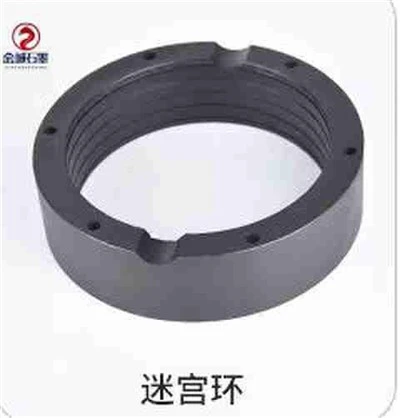
Graphite Pump Seal Ring for Mechanical Shaft Sealing
Jincheng graphite pump seal rings serve as stationary or rotating seal faces in mechanical seals, centrifugal pumps, agitators, compressors and rotary process equipment. The ring forms a precision running face against a mating hard material, controlling leakage along rotating shafts while operating under pressure, temperature and fluid chemistry conditions that demand wear resistance and dimensional stability.
Graphite's self-lubricating nature allows the seal to tolerate marginal lubrication and intermittent dry running without immediate face damage, while its thermal conductivity helps dissipate frictional heat away from the contact band. Rings are machined with controlled flatness, surface finish and cross-sectional geometry to fit standard mechanical seal cartridges and custom pump housings, with impregnation options available for specific fluid and pressure conditions.
Jincheng supplies replacement seal rings in small maintenance batches and production volumes for pump manufacturers and industrial repair facilities. Each ring is lapped and inspected for flatness and face quality, with material grades selected according to shaft speed, sealed fluid, pressure rating and the mating face material used in the seal assembly.
Seal Face Benefits
- Self-lubricating graphite supports controlled boundary contact and limited dry-running tolerance.
- Thermal conductivity moves frictional heat away from the narrow seal face band.
- Low thermal expansion preserves face flatness during temperature and pressure transients.
- Good chemical compatibility with water, acids, solvents, oils and many process fluids.
- Lapped face finish and flatness support low leakage and stable running torque.
- Resin, metal and special impregnation options modify porosity and pressure capability.
- Direct replacement profiles for common mechanical seal sizes and pump models.
Material and Dimension Reference
| Parameter | General Grade | Impregnated Grade |
|---|---|---|
| Material Form | Electrographitized carbon | Resin/metal/antimony impregnated |
| Bulk Density | 1.70-1.85 g/cm³ | 1.90-2.40 g/cm³ depending on impregnant |
| Shore Hardness | 55-75 HSD | 70-95 HSD |
| Flexural Strength | 45-75 MPa | 70-110 MPa |
| Compressive Strength | 130-180 MPa | 180-280 MPa |
| Thermal Conductivity | 70-120 W/mK | 80-150 W/mK |
| Open Porosity | ≤10% | Sealed after impregnation |
| Maximum Operating Temperature | Grade and fluid dependent; typically up to 200-400°C in sealed service | |
| Inner Diameter Range | 8-200 mm | |
| Outer Diameter Range | 15-300 mm | |
| Face Flatness | Within light-band lapped specification | |
| Face Surface Finish | Ra ≤0.2 μm typical | |
| Ring Profiles | Plain, stepped, O-ring groove, anti-rotation slot, custom | |
Equipment and Fluid Applications
- Centrifugal water pumps: Mechanical seal faces in municipal, industrial and building water systems.
- Chemical process pumps: Seals handling acids, alkalis, solvents and corrosive process streams.
- Oil and hydrocarbon pumps: Shaft seals in refinery, fuel transfer and lubrication equipment.
- Agitators and mixers: Rotary seals for vessels, reactors and batch processing equipment.
- Refrigeration and compressors: Seal rings in refrigeration compressors and gas handling machinery.
- Marine and wastewater pumps: Dependable seals under variable lubrication and demanding operating duty.
Verify shaft alignment, seal chamber dimensions and face cleanliness before assembly. Lubricate faces with a compatible fluid during installation, never run a dry seal outside its rated capability, and maintain correct flush and barrier pressure plans. Inspect faces during overhaul for heat checking, grooving, chipping or wear patterns and replace rather than re-lap damaged production rings.
Jincheng Manufacturing Strengths
- Lapping and precision finishing capability for leak-tight seal faces.
- Impregnation options for pressure, porosity and fluid compatibility.
- Reverse engineering of rings from common seal cartridges and worn samples.
- Material pairing guidance against silicon carbide, tungsten carbide and ceramic faces.
- Maintenance spares in small quantities and OEM production supply.
- Dimensional and flatness inspection with documented quality records.
- Protective face packaging to prevent lapped-surface damage in transit.
Frequently Asked Questions
What is the difference between plain and impregnated graphite rings? Plain graphite retains some porosity and is used in lighter, well-lubricated service. Impregnation with resin, metal or antimony seals porosity, increases strength and pressure capability, and improves compatibility with specific fluids. We recommend the construction based on seal pressure and fluid conditions.
Which mating face material works best with graphite? Graphite commonly runs against silicon carbide, tungsten carbide, alumina ceramic or coated metal faces. The best pairing depends on abrasives in the fluid, lubricity, pressure and speed. Graphite is often selected as the softer running face because it can tolerate contact and conform slightly without damaging the hard face.
Can graphite seals survive dry running? Graphite offers better dry-running tolerance than many hard face combinations, but prolonged dry operation still generates heat and can damage the seal, O-rings or fluid film. Short transient dry contact may be tolerated, while continuous dry running requires a specially designed seal and face combination.
Can you match a ring from an existing mechanical seal? Yes. We can work from seal dimensions, cartridge references or physical samples to reproduce inner and outer diameters, step geometry, grooves and anti-rotation features, with lapped flatness restored to sealing specification.
Hot Tags: graphite pump seal ring for mechanical shaft sealing, China graphite pump seal ring for mechanical shaft sealing manufacturers, suppliers, factory, graphite gland packing rings, graphite pressure seal ring, graphite ring for centrifugal pump, graphite ring for compressor seal, graphite ring for dry running seal, graphite ring for high temperature furnace