

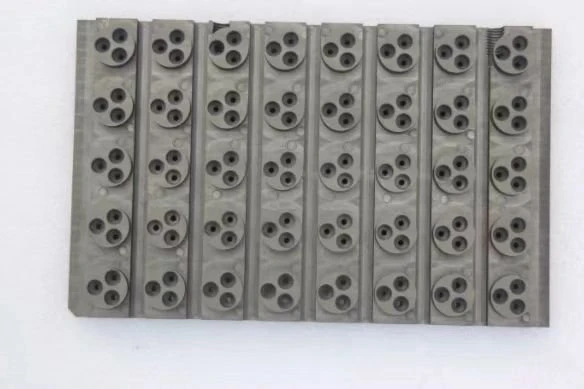
Graphite Ring and Gasket for High Temperature Sealing and Furnace
Product Overview
Our graphite sealing rings and gaskets are precision-machined annular graphite components used to seal furnace doors, feedthroughs, flanges, and chamber penetrations at high temperatures. Unlike elastomer or rubber gaskets that degrade above 250°C, solid graphite seals maintain their integrity in vacuum furnaces, high-temperature piping, and heat treatment equipment operating up to 3000°C. We manufacture graphite seal rings in standard ASA/ANSI flange sizes, custom diameters, and special cross-sections, machined from dense isostatic or expanded flexible graphite depending on the sealing pressure and temperature requirements.
Sealing high-temperature and vacuum equipment requires gaskets that are chemically inert, compressible, and capable of maintaining seal integrity through repeated thermal cycles. At Jincheng Graphite, we supply both rigid solid graphite rings for structural sealing and flexible graphite gaskets for flange sealing. Our rings are used in vacuum furnace door seals, gas-tight electrical feedthroughs, high-temperature flange joints, and sintering furnace chamber seals. We can also supply spiral-wound and corrugated graphite gasket configurations for specialized sealing applications.
Key Features
- High temperature stability - seals maintain integrity up to 3000°C in inert atmosphere
- Vacuum tight - solid graphite rings seal against vacuum and positive pressure
- Chemical inertness - resistant to acids, alkalis, and most process gases
- Compressible - flexible graphite gaskets conform to flange surfaces
- Custom dimensions - rings in any ID/OD combination and cross-section
- Low outgassing - clean vacuum performance without seal contamination
- Thermal cycle resistant - no cracking or shrinking through repeated heating
- Non-aging - does not harden or crack like elastomer gaskets
Technical Specifications
| Parameter | Value |
|---|---|
| Material Options | Solid isostatic graphite / flexible expanded graphite |
| Bulk Density (solid) | 1.75 - 1.85 g/cm³ |
| Density (flexible) | 1.0 - 1.5 g/cm³ |
| Operating Temperature | -200°C to 3000°C (vacuum/inert) |
| Inner Diameter Range | 10 mm - 500 mm |
| Outer Diameter Range | 20 mm - 600 mm |
| Cross Section | 2 mm x 2 mm up to 20 mm x 20 mm |
| Dimensional Tolerance | ±0.2 mm (ID/OD), ±0.1 mm (thickness) |
| Surface Finish | Ra 1.6 µm (machined sealing face) |
| Pressure Rating | up to 10 bar (flexible), up to 5 bar (solid) |
| Flange Standards | ASA/ANSI, DIN, JIS, custom |
| Lead Time | 5-10 business days |
Applications
- Vacuum furnace door seals - graphite gaskets for chamber door and access ports
- Electrical feedthrough seals - rings sealing power and sensor feedthroughs
- High temperature flange joints - gaskets for hot duct and furnace piping flanges
- Sintering furnace chamber seals - seals for controlled-atmosphere furnace shells
- Quartz-to-metal seals - compression rings for quartz tube-to-flange connections
- Laboratory furnace seals - custom rings for research furnace chamber access
Why Choose Jincheng Graphite?
- Sealing expertise - understand both solid and flexible graphite sealing requirements
- Custom ring manufacturing - any ID/OD and cross-section from your drawing
- Standard flange sizes - common ANSI/DIN gasket sizes in stock
- Precision machining - sealing faces machined flat for reliable compression
- Fast delivery - standard rings ship within 3-5 business days
- Cost effective - lower than specialty metal or ceramic seals
- Material recommendation - help select solid vs. flexible for your seal
- Global shipping - furnace builders and OEMs worldwide
FAQ
Q: What is the difference between solid graphite rings and flexible graphite gaskets?
A: Solid graphite rings are rigid, dimensionally stable, and used where the ring itself provides structural support or precise alignment. Flexible graphite gaskets are compressible, conform to flange surface irregularities, and provide better sealing at lower bolt loads. Choose solid for structural seals and flexible for flange face sealing.
Q: Can graphite gaskets be used in air?
A: Flexible graphite gaskets can be used in air up to about 450°C before oxidation becomes significant. Solid graphite oxidizes similarly. For continuous air service above 450°C, we recommend SiC-coated graphite or ceramic gaskets. In vacuum, inert gas, or reducing atmosphere, graphite gaskets are stable to 3000°C.
Q: How do I install graphite seal rings?
A: Clean the flange faces thoroughly. Place the graphite ring squarely on the flange face, ensuring it is not twisted or distorted. Apply even bolt pressure in a diagonal pattern. Do not over-tighten, as solid graphite can crack. Flexible graphite compresses by 30-40% when properly torqued.
Q: Can you supply split rings for installation without disassembly?
A: Yes. We can supply split graphite rings that can be installed around a pipe or shaft without disassembling the existing assembly. The split joint is designed to seal under compression. Specify split-ring construction when ordering.
Hot Tags: graphite ring and gasket for high temperature sealing and furnace, China graphite ring and gasket for high temperature sealing and furnace manufacturers, suppliers, factory, graphite piston ring, graphite ring for low friction system, graphite ring for mechanical system, graphite sealing rings, high density graphite ring, mens graphite rings



