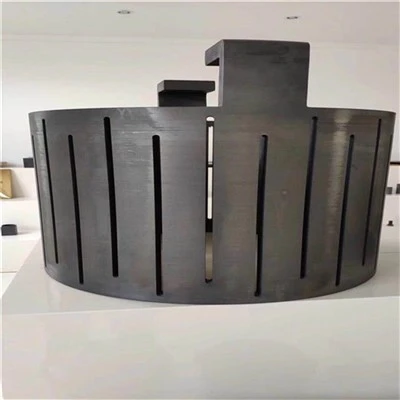
Graphite Degassing Lance For Molten Aluminium Treatment

A degassing lance injects argon or nitrogen below the melt surface, and the gas has to leave the tip as small bubbles rather than one large slug. The lance wall therefore matters as much as the gas pressure: a rough or eroded bore produces slugs, and the hydrogen removal rate collapses.
Our lance is machined from a solid graphite rod with a stepped bore and a perforated tip, so the gas is sheared into a dispersion before it reaches the metal. The outside is protected by a thin ceramic wash where the lance passes through the slag line.
Key Features
-
Stepped internal bore - the bore expands in two stages so gas is sheared before it leaves the tip
-
Perforated dispersion tip - multiple small holes produce a bubble cloud instead of a slug
-
Slag-line protection - ceramic wash can be applied over the section that crosses the surface
-
Threaded or clamped mounting - the head is machined to the existing lance holder
-
Erosion allowance - wall thickness leaves room for one re-bore before replacement
-
Length options - matched to the furnace depth plus the holder offset
Technical Specifications
| Property | Typical Value |
| Grade | fine-grain, low ash |
| Density | 1.85 - 1.92 g/cm3 |
| Ash content | below 0.05 percent |
| Outer diameter | 30 - 90 mm |
| Inner bore | 6 - 20 mm, two stage |
| Tip hole diameter | 1.0 - 3.0 mm |
| Tip hole count | 4 - 20 |
| Length range | 600 - 2500 mm |
| Straightness | 1.0 mm per metre |
| Service temperature | 750 C in aluminium melt |
| Mounting thread | M30 to M60 or clamped |
| Supply form | single lance with tip protection cap |
Applications & How to Use
Rotary degassing units
the lance feeds gas into the rotor head below the melt surface
Lance-only degassing stations
the perforated tip disperses gas where no rotor is used
Transfer ladle treatment
a short lance fits the ladle depth for in-transit degassing
Foundry holding furnaces
the slag-line wash extends life where dross builds up
Replacement of consumable lances
the mounting head copies the existing holder so no adaptor is needed
Why Choose Jincheng
- Bores are drilled and honed so gas flow matches the calculated rate, not the nearest tube size
- Tip holes are counted and measured, because a blocked hole changes the bubble size distribution
- Straightness is checked over the full length, since a bent lance rubs the rotor
- Slag-line wash is applied only where the melt surface sits, saving cost over a full coating
- Lances are individually packed with a tip cap to protect the perforations
- Repeat orders keep the same tip pattern so the degassing curve stays comparable
FAQ
How long does a lance last
In aluminium a lance typically serves several hundred heats, depending on dross practice and whether a slag-line wash is used
Can the tip be re-drilled
Yes, blocked holes can be cleaned or re-drilled once, but the pattern must stay balanced
Why a perforated tip
It shears the gas into many small bubbles, which gives far better hydrogen removal than a single open end
Do you supply the ceramic wash
Yes, the wash is applied over the slag-line section and can be renewed by the customer between campaigns
Related Graphite Products
Hot Tags: graphite degassing lance for molten aluminium treatment, China graphite degassing lance for molten aluminium treatment manufacturers, suppliers, factory, extruded graphite rod, graphite fishing pole, graphite rod bar, graphite rod structural use, graphite stirring rod, high density carbon rod