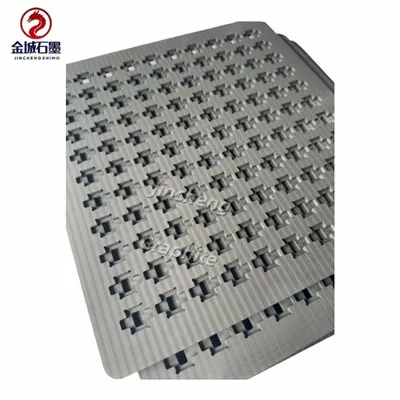
MOCVD Graphite Susceptor for LED & Semiconductor Epitaxy
Jincheng MOCVD graphite susceptors are precision wafer carriers used in metal organic chemical vapor deposition reactors to hold and rotate substrates during epitaxial growth of LED, power semiconductor, radio frequency and advanced optoelectronic devices. Machined from high-purity graphite and protected with a dense silicon carbide coating, each susceptor provides wafer pockets, stable thermal behavior and clean surface conditions essential for uniform thin-film deposition across every substrate.
The susceptor geometry includes precision wafer pockets, gas flow features and spindle interfaces designed for specific reactor models and wafer sizes. The SiC coating seals graphite porosity, resists process gas attack and reduces particle generation, while graphite's thermal conductivity and low expansion support controlled temperature distribution and stable rotation during long deposition cycles. High-purity material and coating construction protect sensitive epitaxial layers from contamination.
Jincheng supplies replacement susceptors for MOCVD equipment and custom wafer carriers for process development, with material documentation and coating inspection. Each component is checked for pocket dimensions, coating continuity, surface quality and spindle fit, and clean packaging supports semiconductor manufacturing service in LED, gallium nitride and compound semiconductor production.
Susceptor Benefits
- High-purity graphite substrate with dense SiC coating for clean epitaxial processing.
- Precision wafer pockets support substrate location and uniform thermal contact.
- Coating seals porosity and reduces particle generation in reactive MOCVD chemistry.
- Thermal conductivity supports controlled, uniform temperature across the carrier.
- Low thermal expansion preserves pocket geometry and spindle fit through cycling.
- Custom profiles for reactor models, wafer sizes and rotation interfaces.
- Clean machined surfaces and coating inspection for semiconductor quality control.
Material and Coating Reference
| Parameter | Graphite Substrate | SiC Coating |
|---|---|---|
| Material | High-purity isostatic graphite | Beta-SiC via CVD |
| Graphite Density | 1.83-1.92 g/cm³ | - |
| Coating Density | - | ≥3.10 g/cm³ |
| Open Porosity | ≤7% | Zero open porosity after coating |
| Coating Thickness | - | 80-200 μm standard, custom |
| Coating Purity | - | ≥99.9% standard, ≥99.99% high purity |
| Wafer Size | 2-8 inch typical, custom | |
| Susceptor Diameter | 100-600 mm | |
| Pocket Features | Wafer recesses, gas slots, rotation holes, spindle interface | |
| Pocket Tolerance | ±0.05 mm on critical dimensions | |
| Surface Finish | Ra ≤0.8 μm coated surface | |
| Maximum Temperature | Up to 1600-1800°C depending on process | |
Epitaxy Applications
- LED epitaxy: Wafer susceptors for gallium nitride and compound semiconductor LED growth.
- Power devices: Carriers for silicon carbide and gallium nitride power semiconductor epitaxy.
- RF and microwave devices: Susceptors supporting high-frequency compound semiconductor deposition.
- Optoelectronics: Wafer carriers for laser diode, detector and advanced optical device growth.
- Reactor maintenance: Replacement susceptors for MOCVD equipment and production spares programs.
- Process development: Custom carriers for new wafer sizes, reactor designs and epitaxy research.
Handle coated susceptors with clean gloves and dedicated tooling, inspect coating and pocket surfaces before loading, and avoid point impact that could crack the hard SiC layer. Verify spindle fit and rotation, maintain process chemistry within rated limits, and store in clean dry packaging to protect semiconductor surfaces.
Jincheng Capability
- High-purity graphite machining with precision wafer pockets.
- CVD SiC coating with continuity and thickness inspection.
- Reactor-specific profiles and spindle interface engineering.
- Replacement and custom susceptors for MOCVD equipment.
- Reverse engineering from existing carriers and drawings.
- Dimensional and coating quality documentation.
- Clean protective packaging for semiconductor export components.
Frequently Asked Questions
Why is SiC coating required on MOCVD susceptors? MOCVD processes use reactive gases and demand clean particle-free surfaces. The SiC coating seals graphite porosity, resists chemical attack and reduces particle generation, while the graphite core provides thermal conductivity and stable wafer support.
What affects epitaxial uniformity across the susceptor? Pocket geometry, thermal distribution, gas flow, rotation stability and coating condition all influence film thickness and properties. Precision pockets and spindle fit, combined with clean coating surfaces, support uniform deposition across every wafer.
Can susceptors be made for specific reactor models? Yes. We can work from reactor drawings, spindle dimensions or existing susceptors to produce matched replacements, including pocket layout, gas features and rotation interfaces for specific MOCVD equipment.
How is coating damage assessed? Cracks, delamination, erosion or exposed graphite can compromise process cleanliness and should be inspected after production cycles. Minor damage is evaluated carefully, while significant coating loss generally requires re-coating or replacement to protect epitaxial quality.
Hot Tags: mocvd graphite susceptor for led & semiconductor epitaxy, China mocvd graphite susceptor for led & semiconductor epitaxy manufacturers, suppliers, factory, graphite bushings for semiconductor equipment, graphite electrodes for ic fabrication, high precision vc sintering heat conducting plate, semiconductor graphite heat sinks, semiconductor graphite uniform temperature plate, wafer graphite carrier