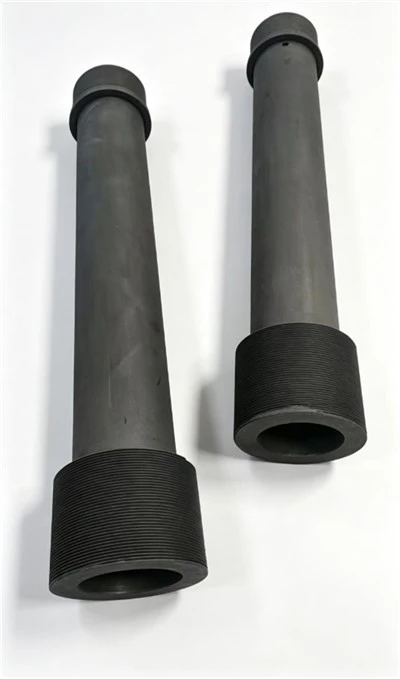
Graphite Stack Assembly with Perforated Bipolar Plates for Fuel Cell Testing
Product Overview
The stack assembly is a pre-built column of many perforated bipolar plates separated by gaskets and end plates, held together by tie rods. It is supplied as a complete repeating unit rather than loose plates, so a researcher can begin fuel cell or electrolyser testing without first developing the stacking sequence.
The perforated plates distribute reactant gas and conduct current between cells, while the end plates apply even compression across the whole face. Because the plates are graphite, they stay conductive and chemically stable in the humid, acidic environment inside the cell.
Jincheng can set the cell count, plate size, and hole pattern to the test specification, and can supply repeat assemblies so results across experiments are comparable.
Key Features and Design Details
- Pre-built complete column saves setup time in the lab
- Perforated plates distribute gas and conduct current
- End plates give even compression across the face
- Chemically stable graphite resists the humid cell environment
- Tie rods hold the stack at controlled load
- Custom cell count, plate size, and hole pattern
Technical Specifications
| Form | column of perforated plates with end plates |
|---|---|
| Plate material | conductive graphite, fine-grain |
| Density | 1.74 - 1.86 g/cm3 |
| Plate size | 100 - 500 mm, custom |
| Cell count | 5 - 100 per assembly |
| Resistivity | 7 - 12 micro;ohm·m |
| Perforation pattern | made to gas flow design |
| Bending strength | 38 - 60 MPa |
| Heat conductivity | 95 - 145 W/m·K |
| Ash content | below 0.1% |
| Tie rod load | set to assembly specification |
| Tolerance | +/-0.03 mm on plate faces |
Applications and How to Use
The assembly is used in fuel cell and electrolyser development rigs and teaching demonstrations. Mount it between the test end plates and confirm the tie rod load is even before introducing gas. Connect the manifolds to the perforation pattern and ramp the gas flow gradually.
Inspect the gaskets and plate faces between experiments and keep the stack dry when not in use, since the humid environment is only benign during controlled operation.
Material Grade Selection and Quality Control
A conductive, chemically stable, low-ash class is used so the plates stay conductive and introduce no contamination. Each assembly is checked for plate alignment, electrical continuity, and compression before packing.
Why Choose Jincheng
- Complete pre-built stack shortens test setup
- Graphite plates stable in the humid acidic cell
- Even compression protects contact and sealing
- Repeat assemblies keep experiments comparable
- Direct factory supply and engineering support
Frequently Asked Questions
Can the cell count be set to my design?
Yes, the plate number and dimensions follow the test specification.
How is even compression achieved?
The end plates and tie rods are loaded to a controlled value across the face.
Why use graphite for the plates?
Graphite stays conductive and chemically stable in the humid cell environment.
Are repeat assemblies identical?
The same plate pattern and dimensions are held so results can be compared.
Hot Tags: graphite bipolar plate stack assembly for fuel cells, China graphite bipolar plate stack assembly for fuel cells manufacturers, suppliers, factory, air cooled energy storage bipolar plate, carbon carbon graphite material, carbon fiber composite parts, carbon fiber composite plate, conductive composite bipolar plate, flexible graphite bipolar plate