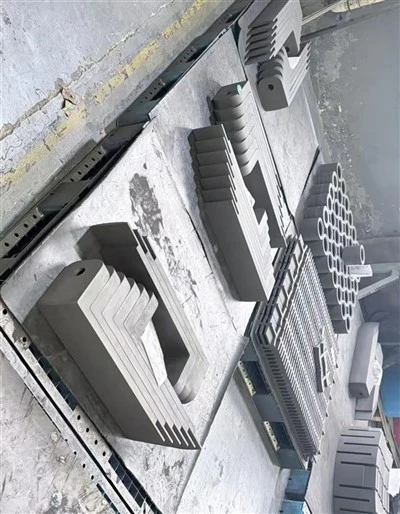
Graphite Baffle Plate For SiC Epitaxy Reactor

A graphite baffle plate sits above the susceptor in a SiC epitaxial reactor and spreads the incoming gas mixture across the wafer before it reaches the growth zone. The hole pattern, the open area and the distance to the susceptor decide whether the precursor stream is uniform or whether it jets onto the centre of the wafer and starves the edge.
Jincheng drills and machines these plates from high-density isostatic graphite, because a SiC epi reactor runs at 1550 to 1650 C in hydrogen with silane and propane additions. At that temperature a plate that is not stress-relieved will bow, and a bowed plate changes the gap and therefore the growth rate. We therefore stress-relieve the blank before final machining and hold the plate flat within 0.1 mm across the full diameter.
Key Features
-
Engineered hole array - Hole diameter, pitch and open area are set from the customer's flow model, typically 1.5 to 4 mm holes at 8 to 15 mm pitch with 8 to 18 percent open area.
-
Flatness held after stress relief - Blanks are graphitised and stress-relieved before final machining, so the plate stays flat within 0.1 mm over a 300 mm span at growth temperature.
-
Uniform temperature field - High thermal conductivity spreads heat from the susceptor so the gas does not see a cold plate in the middle and a hot ring at the edge.
-
Hydrogen-resistant grade - Selected graphite grade with low open porosity reduces hydrogen attack and keeps particle generation low during long epitaxial runs.
-
Custom mounting features - Support holes, threaded inserts and centring steps are machined in the same setup as the hole array to keep everything concentric.
-
Matched to the susceptor - Plates can be supplied as a set with the susceptor and the rotation carrier so the whole hot zone is dimensionally consistent.
Technical Specifications
| Property | Typical Value |
| Material | High-density isostatic graphite, fine grain |
| Bulk density | 1.88 to 1.92 g/cm3 |
| Ash content | Below 30 ppm |
| Plate diameter | 150 to 400 mm |
| Plate thickness | 8 to 25 mm |
| Hole diameter | 1.5 to 4.0 mm |
| Hole pitch | 8 to 15 mm |
| Open area | 8 to 18 percent |
| Flatness | 0.1 mm across the full diameter |
| Through-hole tolerance | +/-0.05 mm |
| Surface roughness | Ra 1.6 um |
| Service temperature | Up to 1800 C in vacuum or hydrogen |
Applications & How to Use
SiC homoepitaxy on 150 mm wafers
The plate is mounted above the susceptor with a measured gap; after each campaign the holes are inspected for silicon deposit and cleaned by high-temperature burn-off.
GaN MOCVD carrier plate
For MOCVD the same plate design is used with a larger open area to handle the higher total flow of ammonia and carrier gas.
Silicon epitaxy retrofit
Older horizontal reactors can be upgraded with a redesigned baffle to reduce centre-to-edge thickness variation.
CVD diamond and carbon materials
Plates with a coarser hole array distribute the hydrogen and methane mixture evenly in diamond growth reactors.
Process development
Small batches with several hole patterns let process engineers compare thickness maps before fixing a production design.
Why Choose Jincheng
- We machine graphite after stress relief, which is the step most suppliers skip and the reason plates bow in service.
- Hole arrays are drilled on a CNC with a recorded program, so a repeat plate matches the first one hole for hole.
- We can supply the baffle, susceptor and carrier as a matched hot-zone set from the same graphite lot.
- Our inspection includes flatness, hole position and open area, reported with the batch.
- Packing uses foam cradles and edge protection so a thin plate arrives flat.
- Engineers review the flow model with the customer when a new design is requested, instead of simply copying the old hole pattern.
FAQ
Why does a baffle plate bow in service?
Residual stress in the blank releases at growth temperature. Stress-relieving the blank before final machining and keeping the plate thickness symmetric around the hole array are the two controls that prevent it.
Can you drill a non-standard hole pattern?
Yes, we program the pattern from a drawing or a coordinate table, and we report the actual hole positions.
What open area should I choose?
It depends on total flow and chamber pressure. As a starting point most SiC epi reactors run 10 to 14 percent open area; we can supply trial plates at two open areas.
Does the plate need a coating?
Uncoated high-purity graphite is normal. A SiC coating can be applied by the customer when the process requires it, but the coating changes the hole diameter, so the plate must be machined to allow for it.
What is the lead time for a custom plate?
A custom plate is typically 15 to 25 days from drawing approval, depending on hole count and the graphite grade.
Related Graphite Products
Hot Tags: graphite baffle plate for sic epitaxy reactor - gas flow distribution plate, China graphite baffle plate for sic epitaxy reactor - gas flow distribution plate manufacturers, suppliers, factory