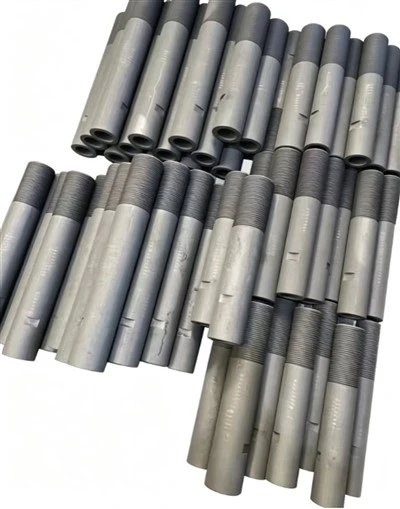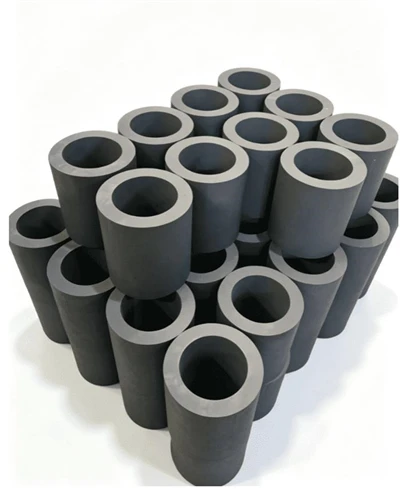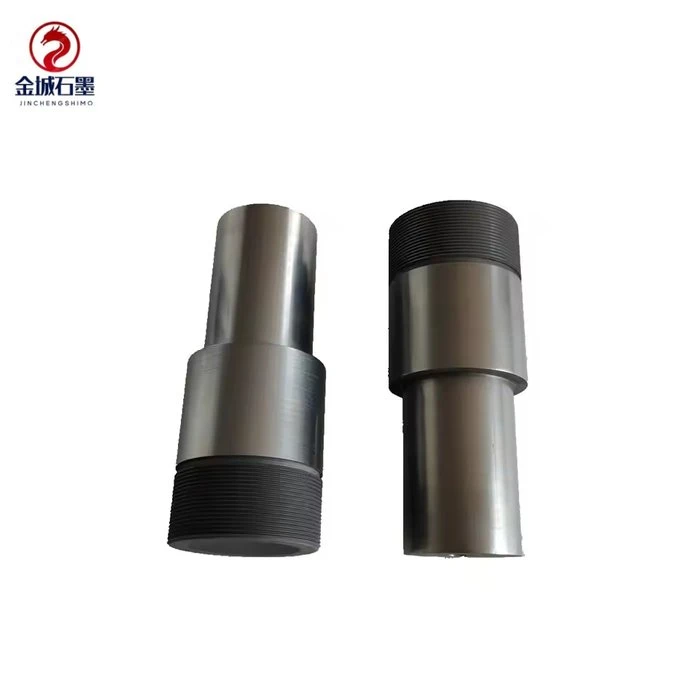
Graphite Insulation Cylinder For Induction Melting Furnace

A graphite insulation cylinder wraps the hot zone of an induction melting or sintering furnace and holds the graphite felt or board that keeps heat inside the working volume. Unlike a flat insulation plate, this part is a full cylinder, so it must be round, straight and stable enough that the felt it carries does not open a gap at the seam.
We machine these cylinders from extruded or isostatic graphite in wall thicknesses from 8 to 30 mm, with an outside diameter up to about 600 mm. The bore is turned round to within 0.2 mm of the drawing, the ends are faced square to the axis, and split versions are supplied where the furnace design requires the cylinder to be removed without lifting the whole hot zone.
Key Features
-
Round and square - The bore is turned and the ends are faced perpendicular to the axis, so the cylinder sits square on the base plate and the felt layer stays uniform around the circumference.
-
Split or one-piece design - One-piece cylinders are used where the furnace is loaded from the top; split cylinders with a machined seam are supplied where the shell has to be removed sideways.
-
Wall thickness to the thermal model - Wall thickness is chosen with the customer so the cylinder has enough stiffness to support the felt but does not waste hot-zone volume.
-
Low-conductivity grade option - Where the cylinder also acts as the first thermal barrier, a lower-density, higher-porosity grade reduces heat loss through the wall.
-
Machined lifting features - Lifting lugs, handling holes and thermocouple ports are cut into the wall so the shell can be lifted safely and instruments can reach the charge.
-
Seam and joint control - On split cylinders the two halves are machined as a pair, so the seam gap stays within 0.5 mm and no hot gas escapes through it.
Technical Specifications
| Property | Typical Value |
| Material | Extruded or isostatic graphite |
| Bulk density | 1.70 to 1.90 g/cm3 |
| Outside diameter | 200 to 600 mm |
| Inside diameter | 150 to 550 mm |
| Wall thickness | 8 to 30 mm |
| Cylinder length | 300 to 1500 mm |
| Bore roundness | 0.2 mm |
| End face squareness | 0.2 mm |
| Seam gap on split cylinders | 0.5 mm maximum |
| Ash content | Below 100 ppm |
| Service temperature | Up to 2000 C in vacuum or inert gas |
| Surface finish | Ra 3.2 um machined |
Applications & How to Use
Induction melting of copper and precious metals
The cylinder carries graphite felt outside the crucible and protects the induction coil former from radiant heat.
Vacuum sintering furnace hot zone
A one-piece cylinder is dropped over the heating element and the felt is packed between cylinder and water jacket.
Graphitisation furnace liner
Split cylinders are used where the furnace is loaded from the side and the liner has to be replaced without dismantling the element.
Aluminium holding furnace
Cylinders with a machined launder opening are used around the melting chamber to reduce shell temperature.
Retrofit of cracked ceramic liners
Where a ceramic shell has cracked from thermal shock, a graphite cylinder with the same outside diameter is a drop-in replacement.
Why Choose Jincheng
- We turn the bore and face the ends in one setup, which is what keeps a tall cylinder square on the base plate.
- Split cylinders are machined as a matched pair so the seam does not open up at temperature.
- We can quote both one-piece and split designs against the same drawing, so the customer chooses based on how the furnace is serviced.
- Cylinders are packed on a wooden cradle with the bore supported, so a long thin shell arrives round rather than oval.
- Wall thickness can be varied along the length where the thermal model calls for extra insulation near the melt.
- Thermocouple and sight ports are drilled to the customer's coordinates, not left for the site to cut.
FAQ
Why choose graphite instead of a ceramic shell?
Graphite takes thermal shock without cracking and can be machined to a precise bore. Ceramic shells are cheaper but brittle when a cold charge drops into a hot furnace.
Can the cylinder be supplied with a seam for side removal?
Yes, we cut the shell into two halves, machine the seam flat and mark the halves so they reassemble in the same orientation.
How is a 1500 mm cylinder shipped without damage?
It travels on a shaped cradle with internal supports and is strapped so the bore cannot distort in transit.
Do you machine ports for thermocouples?
Yes, give us the axial position and the angle, and the ports are drilled and deburred before shipment.
What grade do you recommend for a melting furnace?
For most induction melting shells an extruded grade at 1.75 to 1.85 g/cm3 is sufficient; for a vacuum sintering hot zone a finer isostatic grade holds the bore better.
Related Graphite Products
Hot Tags: graphite insulation cylinder for induction melting furnace - thermal barrier sleeve, China graphite insulation cylinder for induction melting furnace - thermal barrier sleeve manufacturers, suppliers, factory