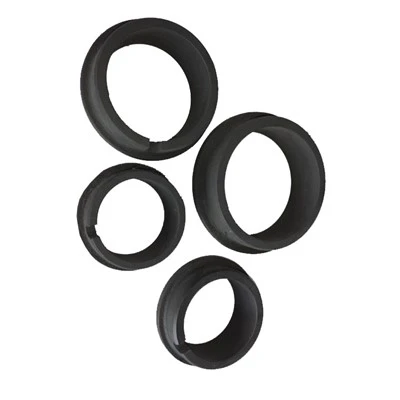
Graphite Cold Finger For Cryogenic Pump Arrays

A cryopump array works by presenting a large cold surface to the gas it must capture. Aluminium fingers deform under repeated regeneration cycles, while graphite holds its shape and releases the captured layer cleanly when the array is warmed.
The finger is machined as a thin-walled rod with a base flange that matches the array plate, so it can be replaced individually. Wall thickness is balanced against thermal conduction: thin enough to cool quickly, thick enough to survive handling and regeneration.
Key Features
-
High thermal conductivity - 100 to 150 W/m.K along the finger axis
-
Dimensionally stable on cycling - no permanent set after repeated cool and warm cycles
-
Clean release of condensate - smooth machined surface lets the captured layer lift off
-
Thin-wall machined form - wall section balanced for cool-down speed and strength
-
Individual replaceability - base flange matches the array plate so one finger can be swapped
-
Low outgassing - dense grade with low open porosity for high vacuum
Technical Specifications
| Property | Typical Value |
| Grade | fine-grain isostatic |
| Density | 1.85 - 1.92 g/cm3 |
| Thermal conductivity | 120 - 150 W/m.K |
| Ash content | below 0.05 percent |
| Finger diameter | 12 - 60 mm |
| Wall thickness | 2 - 8 mm |
| Length range | 80 - 400 mm |
| Coaxiality | 0.05 mm between finger and flange |
| Base flange thickness | 6 - 15 mm |
| Service temperature | -196 to 400 C |
| Surface finish | Ra 1.6 on the condensing surface |
| Supply form | single finger or full array set |
Applications & How to Use
Semiconductor cryopumps
the array captures water and solvent vapour without aluminium cold welding
High vacuum coaters
a graphite finger releases its deposit cleanly at regeneration
R and D vacuum systems
individual fingers can be replaced during experiments
Analytical instruments
low outgassing keeps the background spectrum clean
Sputter chambers
the array tolerates the argon and residual gas mix during cycling
Why Choose Jincheng
- Fingers and flange are machined in one set-up so coaxiality is held without re-chucking
- Wall thickness is agreed against the required cool-down time, not guessed
- Array sets are numbered so a single finger can be reordered later
- Dense grade limits open porosity, which matters at 10 to the minus 7 mbar
- Low-volume trial arrays are accepted
- Protective packing keeps the thin wall from ovalising in transit
FAQ
Will the finger handle regeneration heating
Yes, the grade is chosen for repeated warm-up in vacuum, and the surface does not spall
Can I replace one finger
Yes, each finger carries its position mark and the flange bolts to the array plate
How is coaxiality measured
The finger axis is checked against the flange bore, with 0.05 mm the usual acceptance value
Is aluminium better for cool-down
Aluminium cools faster but deforms, so graphite is used where dimensional stability and clean release matter
Related Graphite Products
Hot Tags: graphite cold finger for cryogenic pump arrays, China graphite cold finger for cryogenic pump arrays manufacturers, suppliers, factory, carbon graphite parts for vacuum furnaces, graphite heating elements vacuum furnace, graphite insulators for vacuum furnaces, graphite parts, vacuum furnace graphite screws, vacuum furnace graphite seals