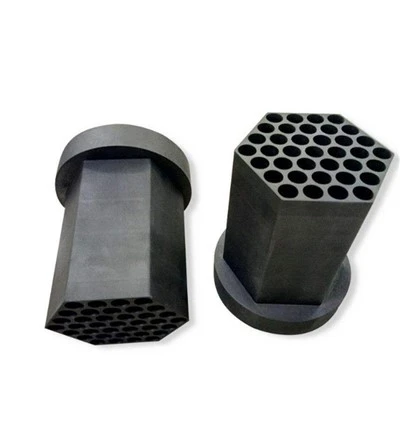
Graphite Current Collector Plate & End Plate for Fuel Cell & Battery Stack Assembly
Product Overview
The graphite current collector plate (also called graphite end plate or current collector) is a high-conductivity, rigid component used at the ends of fuel cell stacks, redox flow batteries, electrolyzers, and electrochemical cell assemblies. It collects and conducts the electrical current generated across the individual cells, distributes clamping force evenly over the stack, and provides a stable, corrosion-resistant interface for external terminals and busbars. Machined from dense, high-purity graphite, the plate combines excellent electrical conductivity with chemical resistance to the acidic or alkaline environments found inside electrochemical devices.
Unlike metal end plates, graphite does not corrode in the presence of electrolytes, humid reactant gases, or catalyst layers, and it will not introduce metal ions that could poison membranes or reduce cell efficiency. The material's low thermal expansion and high stiffness keep the plate flat and dimensionally stable under the sustained compression loads required for leak-free stack sealing. Precision-machined manifolds, locating holes, terminal bores, and gas/liquid ports can be incorporated to match the exact stack architecture, ensuring uniform reactant distribution and reliable current collection over thousands of operating cycles.
Jincheng Graphite supplies custom current collector and end plates in both circular and rectangular formats, tailored to your stack size, port pattern, terminal configuration, and compression requirements. From single prototype plates for laboratory cells to production batches for commercial fuel cell and battery stacks, we deliver flat, high-conductivity graphite components with tight tolerances and the surface quality needed for high-performance electrochemical systems.
Key Features
- High electrical conductivity from dense, fine-grain graphite ensures low-resistance current collection and minimizes ohmic losses across the stack.
- Excellent corrosion resistance withstands acidic/alkaline electrolytes, humid gases, and electrochemical potentials without rusting or releasing metal ions.
- Rigid, flat structure distributes clamping force uniformly across cells and gaskets, supporting gas-tight sealing and preventing localized hotspots.
- Precision-machined ports and manifolds for reactant gas, coolant, and electrolyte flow, plus locating holes and terminal bores matched to your stack design.
- Low thermal expansion maintains flatness and alignment under temperature cycling and sustained compression loads.
- High-purity material with low ash and trace metal content protects membranes, catalysts, and electrolytes from contamination.
- Custom geometry in round or rectangular plates, with grooves, slots, threaded inserts, or metal terminal connections as required.
- Lightweight compared with metal while retaining the stiffness needed for end-plate duty, helping reduce overall stack weight.
Technical Specifications
| Parameter | Specification |
|---|---|
| Material | High-density isostatic molded graphite |
| Bulk Density | 1.75 – 1.90 g/cm³ |
| Electrical Resistivity | 7 – 13 μΩ·m |
| Shore Hardness | 45 – 70 HSD |
| Flexural Strength | 35 – 70 MPa |
| Compressive Strength | 80 – 160 MPa |
| Thermal Conductivity | 80 – 150 W/(m·K) |
| Coefficient of Thermal Expansion | 3.5 – 5.0 × 10⁻⁶ /K |
| Ash Content | ≤ 0.1% (high-purity ≤ 0.03%) |
| Maximum Operating Temperature | 3000°C (inert atmosphere) |
| Plate Shape | Circular or rectangular (custom) |
| Typical Thickness | 5 – 50 mm (custom) |
| Typical Overall Size | 50 – 800 mm (custom) |
| Features | Manifold ports, locating holes, terminal bores, grooves |
| Surface Finish | Precision ground/machined, Ra ≤ 3.2 μm |
Applications & How to Use
- Proton exchange membrane (PEM) fuel cells: End collector plates sit at both ends of the stack, conducting current while clamping the membrane electrode assemblies and bipolar plates together.
- Redox flow batteries: Graphite current collectors interface with the electrode felts and external circuit, resisting corrosion from the flowing electrolyte over long service life.
- Water electrolyzers & hydrogen generation: Collector plates conduct current through the electrolysis cell stack while accommodating gas and water ports.
- Electrochemical test cells: Small precision plates serve as current collectors in laboratory half-cells, coin-cell fixtures, and research stacks.
- Direct methanol and alkaline fuel cells: Chemically resistant graphite plates handle methanol, alkaline media, and humid reactants without degradation.
- Industrial electrolysis and plating: High-conductivity graphite plates act as rigid current feeders in specialized electrochemical processing equipment.
How to use: Verify that all port and hole positions align with the stack manifold and tie-rod pattern. Place the collector plate at the end of the cell stack, with the sealing gasket or insulation layer positioned correctly and the terminal contact area clean and exposed. Apply clamping force gradually and evenly across the tie bolts to the specified torque so the plate stays flat and seals uniformly. Connect the external busbar or terminal to the designated contact area, ensuring a low-resistance joint. During operation, monitor temperature and contact resistance; after disassembly, inspect the surface for cracks or corrosion and re-machine or replace as needed.
Why Choose Jincheng
- Dedicated graphite manufacturer with deep experience in fuel cell, battery, and electrochemical graphite components for global customers.
- Application engineering support to optimize plate thickness, port layout, and terminal design for conductivity, sealing, and clamping performance.
- High-conductivity, high-purity grades selected to minimize contact resistance and protect catalyst and membrane chemistry.
- Precision CNC and grinding capability delivers flat, parallel plates with accurate port positions and smooth sealing surfaces.
- Tight tolerance and quality control with dimensional inspection and material certification on every production batch.
- Flexible prototyping and volume production, supporting stack development from lab scale through commercial manufacture.
- Reliable export packaging that protects flat, brittle graphite plates from chipping and breakage during shipping.
FAQ
1. What is the difference between a bipolar plate and a current collector plate?
Bipolar plates sit between individual cells and contain flow fields that distribute reactant gases across each cell. Current collector (end) plates are placed at the two ends of the stack; they primarily conduct the total current to the external circuit and apply clamping force, and typically do not need the intricate flow-field channels of bipolar plates.
2. Why use graphite instead of coated metal for the end plate?
Graphite is inherently conductive and corrosion-resistant without any coating that can chip or degrade, and it will not leach metal ions into the electrolyte or membrane. It is also lighter than solid metal and provides a stable, flat sealing surface. For very high compression or impact requirements, hybrid designs can be discussed.
3. Can you machine custom ports and terminal holes?
Yes. We machine manifold openings, locating holes, threaded inserts, terminal bores, grooves, and slots based on your drawings or stack model. Send the dimensions and we will confirm manufacturability and tolerances.
4. How flat do the plates need to be?
Flatness is critical for even sealing and current distribution. We machine and grind plates to controlled flatness and parallelism tolerances appropriate to the plate size; specific targets can be agreed based on your gasket and compression design.
5. Does the graphite plate need a surface treatment?
For many fuel cell and battery applications, dense high-purity graphite works well without treatment. If your electrolyte or operating conditions require reduced porosity, impregnation or sealing treatments can be applied; we can recommend an option based on your application details.
Hot Tags: graphite current collector plate & end plate for fuel cell & battery stack assembly, China graphite current collector plate & end plate for fuel cell & battery stack assembly manufacturers, suppliers, factory, graphite insulators for vacuum furnaces, graphite parts, vacuum furnace graphite crucibles, vacuum furnace graphite parts, vacuum furnace graphite screws, vacuum furnace graphite seals