

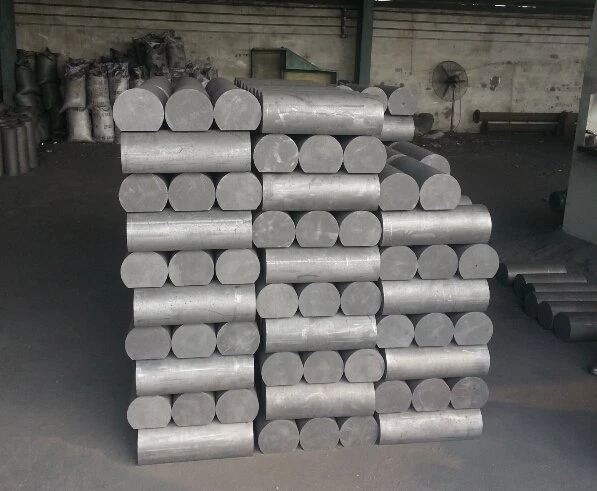
Graphite Rod and Electrodes for Electrical and Conductive Applications
Product Overview
Our electrical graphite rods are precision-extruded and machined cylindrical graphite components used as current conductors, electrodes, contact brushes, and heating elements in electrical applications. Graphite's combination of electrical conductivity, high-temperature stability, self-lubrication, and corrosion resistance makes it superior to copper or steel rods for many electrical and electrochemical uses. We supply solid graphite rods in diameters from 5 mm to 100 mm, cut to custom lengths, with precision-machined ends for threads, press fits, or electrical connection hardware.
Electrical graphite rods serve in a wide range of industries: as anodes in electrochemical cells, as electrodes in spark plug manufacturing, as resistance heaters in furnaces, as contacts in low-voltage switchgear, and as conductive elements in specialty electrical equipment. At Jincheng Graphite, we stock a full range of extruded graphite rods in standard diameters and lengths, and precision-machine custom rods with threaded ends, chamfers, and center holes as required. Our rods are consistently sized and dimensionally accurate for reliable electrical contact.
Key Features
- Electrical conductivity - consistent resistivity for reliable current flow
- High temperature stable - maintains conductivity at elevated temperatures
- Self-lubricating - graphite film reduces friction in moving contact applications
- Corrosion resistant - stable in electrolytes and chemical environments
- Wide diameter range - 5 mm to 100 mm solid rods
- Custom lengths - cut to your exact length requirements
- Machined ends - threads, chamfers, and center holes as needed
- Good machinability - drills, turns, and threads cleanly for custom fabrication
Technical Specifications
| Parameter | Value |
|---|---|
| Material | Extruded / isostatic graphite |
| Bulk Density | 1.60 - 1.78 g/cm³ |
| Electrical Resistivity | 8 - 15 µΩ·m |
| Flexural Strength | 20 - 40 MPa |
| Diameter Range | 5 mm - 100 mm |
| Length Range | 50 mm - 1000 mm |
| Diameter Tolerance | ±0.2 mm (ground) / ±0.5 mm (as extruded) |
| Length Tolerance | ±1 mm (cut to length) |
| Straightness | < 0.3 mm per 300 mm |
| Surface Finish | Ra 3.2 µm (machined) |
| Max Temperature | 3000°C (vacuum/inert) |
| Lead Time | 5-10 business days |
Applications
- Electrochemical anodes - graphite anodes for electrolysis and electroplating
- Resistance heating elements - graphite rod heaters in high-temperature furnaces
- Electrical contacts and brushes - conductive contacts in switchgear and motors
- Spark plug electrodes - electrode rods for spark plug manufacturing
- Glass melting electrodes - electrodes in electric glass melting furnaces
- Semiconductor wafer support - conductive rods in wafer processing equipment
Why Choose Jincheng Graphite?
- Stock diameter range - wide range of standard rod diameters available
- Consistent resistivity - batch-to-batch electrical consistency
- Precision grinding - ground rods for tight diameter tolerances
- End machining - threads, chamfers, and center holes for your assembly
- Fast delivery - standard rods ship within 3-5 business days
- Competitive pricing - factory-direct graphite rod supply
- Material selection - recommend grade based on conductivity and temperature
- Global shipping - electrical equipment manufacturers worldwide
FAQ
Q: How does graphite conductivity compare to copper?
A: Graphite has higher electrical resistance than copper (resistivity 8-15 µΩ·m vs. 0.017 µΩ·m for copper). However, graphite's advantages are high-temperature stability, corrosion resistance, and self-lubrication. For low-resistance, low-temperature applications, copper is better. For high-temperature or corrosive environments, graphite is the only practical choice.
Q: Can graphite rods be threaded?
A: Yes. Graphite machines and threads well. We can cut external or internal threads on rod ends for mounting, connection, or electrical terminal attachment. Specify thread standard (Metric, NPT, UNC/UNF) when ordering.
Q: What diameter tolerance can you hold?
A: As-extruded rods have a diameter tolerance of about ±0.5 mm. Precision-ground rods can hold ±0.1-0.2 mm. For electrical contact applications requiring exact fit, we recommend specifying ground finish.
Q: How do I choose the right graphite grade for electrical use?
A: For heating elements, use low-resistivity extruded graphite. For electrochemical anodes, use dense, fine-grain isostatic graphite that resists electrolyte erosion. For mechanical contact brushes, use a medium-grain grade with good lubrication. Tell us your application and we will recommend the optimal grade.
Hot Tags: graphite rod and electrodes for electrical and conductive applications, China graphite rod and electrodes for electrical and conductive applications manufacturers, suppliers, factory, graphite rod billet, graphite rod heating element, graphite rod square stock, graphite rod structural use, graphite rod thermal grade, natural graphite


