Graphite component manufacturing has been transformed over the past decade by revolutionary advancements in computer numerical control (CNC) machining technology, dust extraction systems, and cutting tool engineering. What was once a labor-intensive, relatively low-precision process has evolved into a high-precision, highly automated manufacturing discipline capable of producing complex graphite components with micron-level tolerances. These technological advancements have expanded the range of viable graphite applications across semiconductor, aerospace, fuel cell, and medical industries while dramatically improving production efficiency and workplace safety.
The global graphite machining market has grown steadily alongside the expanding range of high-value graphite applications, with the broader graphite special-shaped parts market reaching approximately USD 1.32 billion in 2025 and projected to grow at a 6.4% CAGR through the early 2030s. The Asia-Pacific region dominates production with 57.63% market share, led by China's massive manufacturing ecosystem and rapidly expanding domestic demand for high-precision graphite components. Within this market, high-precision CNC-machined graphite parts command significant price premiums over conventionally produced components, reflecting both their higher performance value and the sophisticated manufacturing capabilities required to produce them.
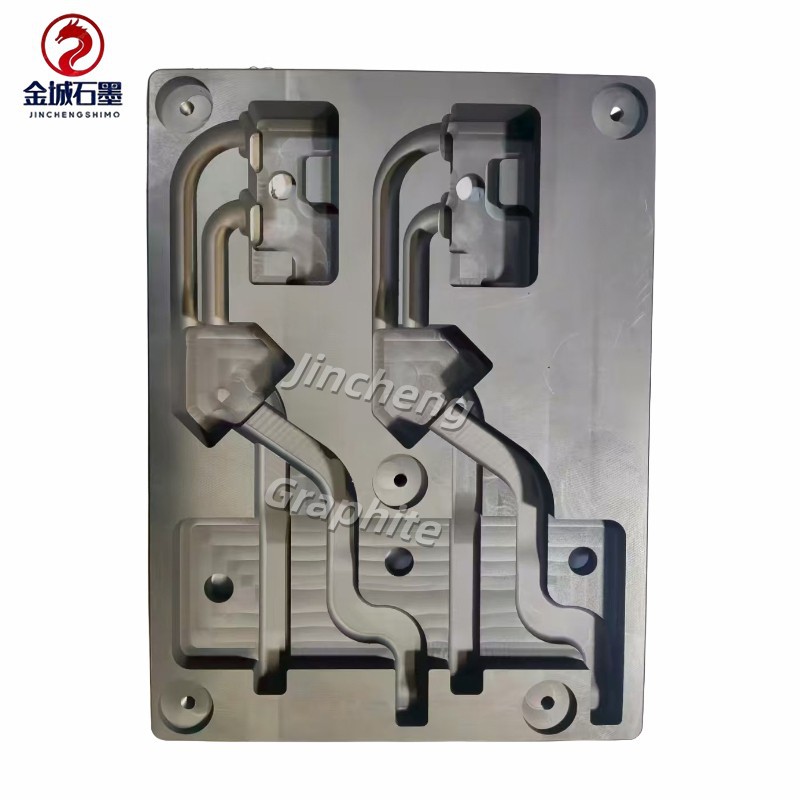
Modern graphite-specific CNC machining centers differ substantially from standard metalworking machines. They incorporate fully enclosed machining chambers with integrated high-efficiency dust extraction systems that capture graphite dust at the source, maintaining clean factory environments and protecting worker health. Advanced machines feature high-speed spindles operating at 20,000–60,000 RPM, enabling fast, clean cutting of graphite with minimal tool wear. Many systems also incorporate automated tool changers, in-process measurement probes, and robotic part loading/unloading for lights-out production, significantly increasing throughput and reducing labor costs.
Cutting tool technology has been equally transformative. Diamond-coated end mills and PCD (polycrystalline diamond) tools have become standard for high-volume graphite machining, offering 10–50 times longer tool life compared to traditional carbide tools. This dramatic improvement in tool durability reduces tool change downtime, improves consistent machining quality across production runs, and lowers per-part tooling costs. For ultra-precision applications requiring mirror-like surface finishes, specialized micro-grain diamond tools can achieve surface roughness values below Ra 0.5μm on graphite surfaces-quality levels that were once only achievable with manual polishing.
These machining advancements have enabled entirely new categories of graphite components. In the semiconductor industry, complex graphite hot zone components with intricate cooling channels and precision alignment features are now machined to single-digit micron tolerances. In fuel cell manufacturing, bipolar plates with complex, miniaturized flow channel geometries can be mass-produced with consistent precision. In aerospace and defense, graphite components with optimized lightweight structural designs are machined from solid isostatic graphite blocks with exceptional dimensional accuracy. None of these applications would be economically feasible at scale without modern CNC graphite machining technology.
Huixian Jincheng Abrasive & Graphite Mold Factory exemplifies how advanced CNC machining technology has elevated the capabilities of mid-sized specialized graphite manufacturers. Founded in 1984 in Huixian City, Henan Province, the company has continuously upgraded its machining infrastructure over the decades, evolving from basic manual equipment to a modern production facility housing over 50 advanced CNC graphite machining centers.
Jincheng Graphite's CNC fleet includes high-speed milling machines, precision surface grinders, and specialized graphite processing equipment, all equipped with dedicated dust extraction systems to ensure clean, efficient production. The company's maximum processing dimension of 1,000mm allows it to handle both small, intricate precision components and larger-format parts such as furnace linings, large crucibles, and big-format bipolar plates. Skilled machinists and programming engineers work with customer CAD drawings to optimize tool paths, machining parameters, and fixturing strategies, balancing production speed with precision and surface quality requirements.
The company's machining capabilities are complemented by secondary finishing operations including precision lapping, polishing, and vacuum impregnation treatments that enhance the performance of finished components. Comprehensive quality inspection-including coordinate measuring machine (CMM) verification, surface roughness testing, and dimensional inspection-ensures that every machined component meets customer specifications. With an annual production value of RMB 20 million, Jincheng Graphite demonstrates how strategic investment in modern machining technology enables a regional manufacturer to compete effectively in high-precision graphite component markets.

Looking forward, graphite machining technology will continue advancing along several key trajectories. Artificial intelligence and machine learning will optimize machining parameters in real time, further improving tool life, surface quality, and production efficiency. Additive manufacturing (3D printing) of graphite components will complement subtractive CNC machining for certain complex geometries that are impractical to mill. And automation will continue advancing, with more robotic material handling and inline quality inspection reducing labor requirements and improving consistency. For graphite manufacturers like Jincheng Graphite that stay at the forefront of machining technology, these trends will open doors to ever more sophisticated applications and higher-value market opportunities.