

China's graphite processing industry has undergone a remarkable transformation over the past two decades, evolving from basic raw material processing to high-precision, value-added manufacturing of advanced graphite components. Today, Chinese graphite manufacturers supply a substantial share of the world's industrial graphite products-from metallurgical electrodes and refractory components to high-precision parts for semiconductors, fuel cells, and battery manufacturing. This ascent reflects decades of investment in production technology, process engineering, and workforce development.
According to Mordor Intelligence analysis, the Asia-Pacific region controls 55.72% of global graphite market revenue, with China as the undisputed regional leader. The country commissioned 1.2 million tons per year of new synthetic graphite capacity between 2024 and 2025 alone, primarily to serve battery giants like CATL and BYD. But beyond battery anode materials, China's precision graphite processing sector has made particularly impressive strides, producing increasingly sophisticated components that compete directly with established Japanese and European manufacturers in many industrial applications.
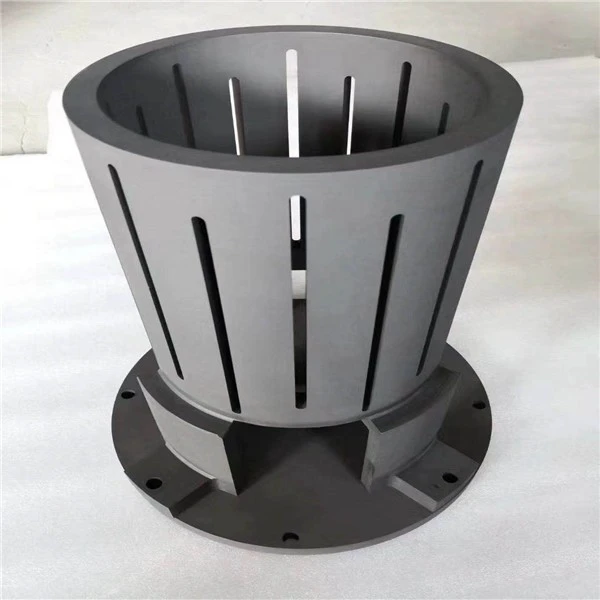
graphite factory CNC machining equipment
Several factors underpin China's competitiveness in graphite processing. First, the country has developed a complete integrated supply chain spanning raw material sourcing (both domestic natural graphite and imported feedstocks), powder processing, forming, baking, impregnation, graphitization, and final precision machining. This vertical integration reduces logistics costs, shortens production lead times, and enables tight quality control throughout the manufacturing process. Second, China's substantial investments in CNC machining infrastructure have dramatically improved processing precision and production efficiency. Modern graphite-specific CNC machines with dust extraction systems, high-speed spindles, and diamond tooling enable Chinese factories to produce complex geometries with tolerances measured in microns.
Third, the concentration of downstream manufacturing industries in China-including rare earth smelting, diamond tool production, photovoltaic manufacturing, battery production, and increasingly fuel cell assembly-creates large domestic demand that graphite processors can serve with proximity advantages. This home-market advantage enables manufacturers to refine their products through close customer collaboration before expanding internationally.
Huixian Jincheng Abrasive & Graphite Mold Factory exemplifies the evolution of China's specialized graphite processing enterprises. Founded in 1984 in Huixian City, Henan Province-one of China's traditional graphite processing hubs-the company has grown from a small workshop producing basic graphite molds into a modern precision manufacturer serving domestic and international customers across multiple industries.
With over 50 processing machines including advanced CNC graphite machining centers, Jincheng Graphite delivers precision components with maximum dimensions up to 1000mm and tight dimensional tolerances. The company's product portfolio spans fuel cell graphite bipolar plates, diamond sintering graphite molds, rare earth electrolysis graphite anodes, curved graphite bricks for high-temperature furnaces, EDM electrodes, and various custom graphite parts. This diversified product range reflects the company's ability to apply its core graphite processing expertise across multiple industrial sectors.

graphite factory CNC machining equipment
Jincheng Graphite's manufacturing capabilities illustrate the sophisticated processing techniques now standard among leading Chinese graphite firms. Their powder compression molding process, combined with multiple vacuum impregnation cycles and high-temperature graphitization above 2600°C, produces high-density graphite materials with excellent uniformity and performance consistency. The company sources raw materials strategically, offering customers a choice of isostatic graphite, molded graphite, and imported premium graphite grades depending on performance requirements and budget considerations.
Quality management has also improved dramatically across China's graphite processing industry. Leading manufacturers like Jincheng Graphite implement rigorous inspection protocols covering density testing, resistivity measurement, gas permeability analysis, dimensional verification, and surface finish inspection. This focus on quality has been essential for gaining acceptance among international customers with stringent quality requirements.
Looking ahead, Chinese graphite manufacturers face both opportunities and challenges. The global energy transition continues to drive strong demand growth for graphite products across batteries, fuel cells, and renewable energy equipment. At the same time, trade policy uncertainties, export control considerations, and efforts by other countries to build domestic graphite processing capacity create competitive pressures. For established players like Jincheng Graphite with deep technical expertise, strong quality systems, and diversified customer bases, the path forward lies in continuing to move up the value chain toward higher-purity, higher-precision, higher-margin products while maintaining the cost competitiveness that has been foundational to China's graphite industry success.
