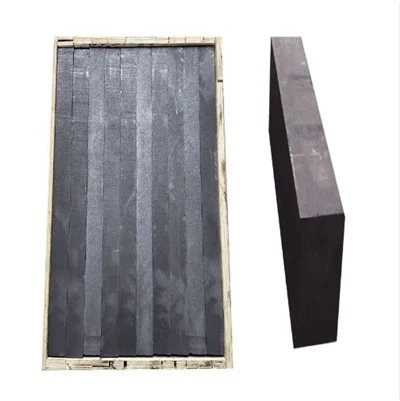
Graphite Heat Spreader For SiC Power Modules

SiC dies run hotter and switch faster than silicon, so the heat flux under the die is higher and the spreader has to move that heat sideways before it reaches the interface. A spreader that is too thin simply passes the hot spot through.
Graphite spreads heat in the plane of the plate, which is exactly the direction a power module needs, and its expansion is close enough to the ceramic substrate that the solder joint is not sheared during cycling.
Plates are machined with a die-attach face and a base face, both lapped. Where the module needs isolation, a ceramic layer can be supplied bonded to the base face and the plate height is adjusted to suit.
Key Features
-
In-plane heat spreading - lateral conduction spreads the die hot spot before it reaches the interface
-
Expansion matched to ceramic - lower shear on the die-attach and base joints during cycling
-
Lapped die-attach face - flatness supports a thin, void-free solder layer
-
Bonded isolation option - ceramic layer supplied as part of the finished height
-
Light weight - lower mass than a copper spreader of the same footprint
-
Custom footprints - outline and die window machined to the module design
Technical Specifications
| Property | Typical Value |
| Grade | high-density, high-purity |
| Density | 1.90 - 1.98 g/cm3 |
| Thermal conductivity | 150 - 190 W/m.K in plane |
| Thermal expansion | 4.2 - 4.8 x 10⁻⁶ per K |
| Thickness | 2 - 10 mm |
| Flatness | 0.03 mm |
| Surface finish | Ra 0.4 on the die face |
| Footprint | up to 200 mm by 150 mm |
| Die window depth | 0.1 - 0.5 mm if required |
| Ash content | below 0.03 percent |
| Isolation layer | optional AlN or Al2O3 |
| Supply form | plain plate or plate with bonded layer |
Applications & How to Use
SiC traction modules
the spreader moves the higher die flux sideways before the interface
Fast switching converters
in-plane spreading limits the peak junction temperature
Aerospace power units
light weight matters where mass is constrained
Test and characterisation rigs
matched expansion keeps the joint intact through cycling
Replacement of copper spreaders
graphite reduces the shear on the die attach
Why Choose Jincheng
- Die faces are lapped to Ra 0.4 so the solder layer can be thin and void-free
- Flatness is checked at 0.03 mm, which matters more for SiC than for silicon
- Expansion and conductivity are reported for the batch, not catalogued
- Bonded isolation layers are included in the finished height
- Die windows and steps are machined before the final lap
- Plates are packed individually with the lapped face protected
FAQ
Can graphite take a die-attach solder cycle
Yes, provided the expansion is matched to the substrate, which is why graphite is chosen for SiC
How thin can the plate be
Down to about 2 mm, but the thickness must still spread the die flux
Do you bond the ceramic layer
Yes, AlN or alumina layers can be supplied bonded and lapped as part of the plate
Is surface finish critical
For die attach it is, because a rough face needs a thicker solder layer and generates voids
Related Graphite Products
Hot Tags: graphite heat spreader for sic power modules, China graphite heat spreader for sic power modules manufacturers, suppliers, factory, graphite block for arc furnace system, graphite block for ceramic industry, graphite block for coating system, graphite block for high temperature testing, graphite block for solar industry, graphite welding block