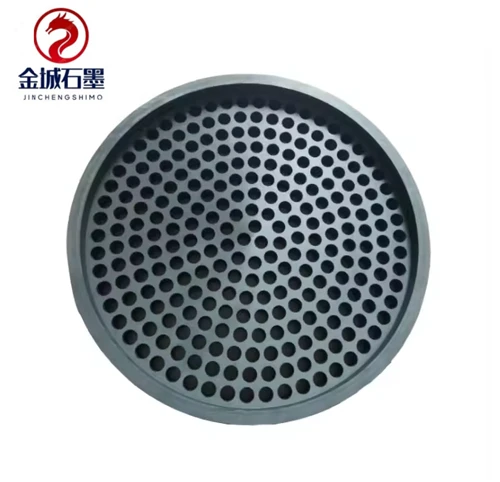
1. Introduction to Graphite Sagger Coatings
1.1 Why Coat Graphite Saggers?
Graphite is an excellent material for high-temperature applications due to its exceptional thermal conductivity, thermal shock resistance, and mechanical strength at elevated temperatures. However, graphite suffers from several limitations that coatings address:
Key Limitations of Uncoated Graphite:
Oxidation Susceptibility: Graphite begins oxidizing at temperatures above 450°C in air, leading to progressive weight loss and structural degradation
Chemical Reactivity: Can react with certain battery material chemistries, causing contamination
Porosity: Natural porosity allows molten materials to penetrate, reducing service life
Abrasion Wear: Material handling and thermal cycling cause surface wear
Benefits of Coated Graphite Saggers:
Extended service life (2-5x improvement)
Reduced product contamination
Improved thermal uniformity
Lower total cost of ownership
Better surface finish quality
Reduced maintenance and replacement frequency
1.2 Coating Technology Overview
Four coating technologies dominate the advanced graphite sagger market:
|
Coating Type |
Market Share (2026) |
Typical Temperature Range |
Key Advantage |
|
Silicon Carbide (SiC) |
58% |
Up to 1,650°C |
Excellent oxidation resistance, cost-effective |
|
Silicon Nitride (Si₃N₄) |
22% |
Up to 1,450°C |
Superior thermal shock resistance, high purity |
|
Zirconium Diboride (ZrB₂) |
8% |
Up to 2,200°C |
Ultra-high temperature capability |
|
Nanocomposite |
12% |
Up to 1,800°C |
Multi-functional, customizable properties |
________________________________________________________________________________
2. Silicon Carbide (SiC) Coatings
2.1 Technology Fundamentals
Silicon carbide coatings are the most widely used coating technology for graphite saggers, offering an excellent balance of performance and cost. SiC coatings are typically applied through chemical vapor deposition (CVD) or reaction-bonded processes.
Coating Characteristics:
Hardness: 25-30 GPa (Mohs 9.5)
Thermal Conductivity: 120-270 W/m·K
Coefficient of Thermal Expansion: 4.0-4.5 × 10⁻⁶ /°C
Typical Coating Thickness: 50-200 μm
Density: 3.21 g/cm³
Deposition Methods:
Chemical Vapor Deposition (CVD): High purity, excellent uniformity, precise thickness control
Reaction-Bonded SiC (RBSC): Lower cost, good adhesion, thicker coatings possible
Slurry/Spray Coatings: Cost-effective, suitable for large surfaces
2.2 Performance Characteristics
Oxidation Resistance:
SiC coatings provide excellent oxidation resistance through the formation of a protective silica (SiO₂) layer at high temperatures. This glassy layer acts as a barrier against further oxygen diffusion.
Onset of oxidation: ~800°C (passive oxidation)
Active oxidation: Above 1,600°C in low oxygen partial pressure
Weight loss rate: 0.1-0.5 mg/cm²·hr at 1,200°C in air
Thermal Shock Resistance:
Thermal shock parameter (R): 250-350°C
Can withstand: ΔT of 800-1,000°C without failure
Thermal cycling performance: Excellent, withstanding 500+ cycles
Chemical Compatibility:
Excellent with: Most oxide ceramics, lithium compounds, alkaline earths
Good with: Nitrides, carbides
Poor with: Strong alkalis at high temperatures, certain molten metals
2.3 Applications and Use Cases
Primary Applications:
Lithium Iron Phosphate (LFP) Cathode Sintering
- Temperature: 700-900°C
- Atmosphere: Air or oxygen
- Benefit: Excellent oxidation resistance, cost-effective
NCM Cathode Material Sintering
- Temperature: 800-1,000°C
- Atmosphere: Oxygen
- Benefit: Good chemical stability, long service life
Electronic Ceramics
- Temperature: 1,200-1,500°C
- Atmosphere: Air
- Benefit: High purity, consistent performance
Powder Metallurgy
- Temperature: 1,000-1,400°C
- Atmosphere: Inert or reducing
- Benefit: Durability, wear resistance
Case Study: LFP Cathode Production
A major Chinese LFP manufacturer switched from uncoated to SiC-coated graphite saggers in 2024:
Before: Uncoated saggers lasted 25-30 cycles
After: SiC-coated saggers lasted 80-90 cycles
Service Life Improvement: 230%
Cost Savings: 45% reduction in sagger cost per ton of product
Additional Benefit: 2% improvement in product yield due to reduced contamination
2.4 Advantages and Limitations
Advantages:
Cost-Effective: Best performance-to-cost ratio among advanced coatings
Proven Technology: Decades of industrial application experience
Good Oxidation Resistance: Suitable for most air-atmosphere processes
High Thermal Conductivity: Promotes uniform heating
Wide Availability: Many suppliers, competitive pricing
Good Mechanical Strength: Resists wear and handling damage
Limitations:
Thermal Shock Sensitivity: Can crack under extreme thermal gradients
Limited Alkaline Resistance: Degraded by strong alkalis at high temperatures
Coating Brittleness: Can chip or crack under mechanical impact
Porous Structure: RBSC coatings may have residual porosity
________________________________________________________________________________
3. Silicon Nitride (Si₃N₄) Coatings
3.1 Technology Fundamentals
Silicon nitride coatings represent a premium coating solution, offering superior thermal shock resistance and exceptional purity. These coatings are particularly valued for high-end battery material applications where contamination control is critical.
Coating Characteristics:
Hardness: 15-20 GPa
Thermal Conductivity: 20-30 W/m·K (lower than SiC)
Coefficient of Thermal Expansion: 2.5-3.2 × 10⁻⁶ /°C
Typical Coating Thickness: 30-100 μm
Density: 3.44 g/cm³
Fracture Toughness: 5-8 MPa·m^(1/2) (superior to SiC)
Deposition Methods:
Chemical Vapor Deposition (CVD): High purity, precise control
Reaction Bonding: In-situ formation through nitridation
Physical Vapor Deposition (PVD): Thin, dense coatings for special applications
3.2 Performance Characteristics
Thermal Shock Resistance:
Silicon nitride coatings offer exceptional thermal shock resistance, making them ideal for rapid thermal cycling processes.
Thermal shock parameter (R): 500-700°C
Can withstand: ΔT of 1,200-1,500°C without failure
Thermal cycling performance: Outstanding, withstanding 1,000+ cycles
Key factor: Lower CTE and higher fracture toughness compared to SiC
Oxidation Resistance:
Onset of oxidation: ~900°C (higher than SiC in initial stages)
Protective layer: Forms silica and silicate layers
Weight loss rate: 0.05-0.2 mg/cm²·hr at 1,200°C in air
Long-term stability: Excellent up to 1,400°C
Purity and Contamination Control:
Si₃N₄ coatings offer exceptional purity levels, making them ideal for applications where contamination is a critical concern.
Purity levels: 99.99%+ achievable with CVD
Metal impurities: < 10 ppm total
Carbon pickup: Minimal due to dense barrier layer
Product contamination: 50-80% reduction compared to uncoated
3.3 Applications and Use Cases
Primary Applications:
Silicon-Carbon Anode Material Sintering
- Temperature: 900-1,200°C
- Atmosphere: Inert (argon/nitrogen)
- Benefit: Excellent thermal shock resistance, high purity
High-Nickel NCM Cathode Sintering
- Temperature: 750-850°C
- Atmosphere: Oxygen
- Benefit: Low contamination, consistent product quality
Solid-State Battery Electrolyte Sintering
- Temperature: 800-1,100°C
- Atmosphere: Controlled atmosphere
- Benefit: Ultra-high purity, chemical inertness
Advanced Electronic Ceramics
- Temperature: 1,000-1,400°C
- Atmosphere: Nitrogen or inert
- Benefit: Precision, purity, thermal stability
Case Study: Silicon-Carbon Anode Production
A leading Chinese anode manufacturer (customer of Huixian Jincheng Abrasive Mould Factory) implemented Si₃N₄-coated saggers for their silicon-carbon anode line:
Before: SiC-coated saggers lasted 40-50 cycles
After: Si₃N₄-coated saggers lasted 120-140 cycles
Service Life Improvement: 180%
Cost Savings: 38% reduction in sagger cost per ton
Quality Improvement: 3% increase in first-pass yield due to reduced contamination
Additional Benefit: Reduced downtime for sagger replacement
3.4 Advantages and Limitations
Advantages:
Superior Thermal Shock Resistance: Best among common coating materials
High Purity: Minimal contamination risk
Excellent Fracture Toughness: Resists cracking and chipping
Good Chemical Inertness: Compatible with many chemistries
Low Friction Coefficient: Easy demolding, reduced material sticking
Smooth Surface Finish: Better product surface quality
Limitations:
Higher Cost: 50-100% more expensive than SiC coatings
Lower Thermal Conductivity: May affect temperature uniformity
Lower Maximum Temperature: Limited to ~1,450°C in oxidizing environments
Fewer Suppliers: More specialized technology
Longer Lead Times: Complex manufacturing process
________________________________________________________________________________
4. Zirconium Diboride (ZrB₂) Coatings
4.1 Technology Fundamentals
Zirconium diboride coatings represent the cutting edge of ultra-high-temperature coating technology. While more expensive and less common than SiC or Si₃N₄, ZrB₂ coatings offer unmatched performance in extreme temperature environments.
Coating Characteristics:
Hardness: 20-25 GPa
Thermal Conductivity: 50-100 W/m·K
Coefficient of Thermal Expansion: 5.5-6.5 × 10⁻⁶ /°C
Typical Coating Thickness: 20-80 μm
Density: 6.09 g/cm³
Melting Point: 3,245°C (one of the highest known)
Deposition Methods:
Chemical Vapor Deposition (CVD): High quality, uniform coverage
Physical Vapor Deposition (PVD): Precise thickness control
Plasma Spray: Thick coatings for extreme environments
Slurry Dip/Sinter: Cost-effective for certain applications
4.2 Performance Characteristics
Ultra-High Temperature Performance:
ZrB₂ coatings excel in extreme temperature environments where other coatings fail.
Maximum service temperature: 2,200°C in inert atmosphere
Oxidation resistance: Good up to 1,500°C in air
Thermal stability: No phase changes or decomposition at service temperatures
High-temperature strength: Retains mechanical properties at extreme heat
Oxidation Behavior:
ZrB₂ exhibits unique oxidation behavior at high temperatures:
Below 1,200°C: Forms protective B₂O₃ glass layer
1,200-1,500°C: B₂O₃ evaporates, ZrO₂ layer forms
Above 1,500°C: ZrO₂ provides some protection but less effective
Optimal oxidation range: 800-1,200°C
Chemical Compatibility:
Excellent with: Molten metals, borides, carbides
Good with: Most oxides at moderate temperatures
Specialized for: Ultra-high temperature ceramics (UHTC) processing
4.3 Applications and Use Cases
Primary Applications:
Ultra-High-Temperature Ceramic Sintering
- Temperature: 1,600-2,000°C
- Atmosphere: Inert or vacuum
- Benefit: Unmatched high-temperature stability
Specialty Battery Materials
- Temperature: 1,200-1,500°C
- Atmosphere: Controlled
- Benefit: Extended service life in aggressive environments
Rare Earth Magnet Processing
- Temperature: 1,000-1,300°C
- Atmosphere: Inert
- Benefit: Chemical inertness, contamination control
Advanced Nuclear Materials
- Temperature: 1,200-1,800°C
- Atmosphere: Specialized
- Benefit: Radiation resistance, high-temperature stability
Case Study: Advanced Ceramic Composite Production
A European advanced ceramics company adopted ZrB₂-coated graphite fixtures for their ultra-high-temperature sintering line:
Before: SiC-coated fixtures lasted 15-20 cycles at 1,700°C
After: ZrB₂-coated fixtures lasted 60-70 cycles
Service Life Improvement: 300%
Cost Savings: 55% despite higher initial coating cost
Process Improvement: Enabled 100°C higher process temperature
4.4 Advantages and Limitations
Advantages:
Ultra-High Temperature Capability: Far exceeds SiC and Si₃N₄
High Thermal Conductivity: Good heat transfer properties
Excellent Chemical Inertness: Resists many aggressive chemistries
High Hardness: Excellent wear resistance
Good Thermal Shock: Reasonable thermal shock resistance
Unique Properties: Enables processes not possible with other coatings
Limitations:
High Cost: 2-3 times more expensive than SiC coatings
Limited Suppliers: Very few manufacturers with expertise
Oxidation Above 1,500°C: Performance degrades in air at very high temps
High Density: Adds significant weight to saggers
Thermal Expansion Mismatch: Higher CTE can cause adhesion issues
Specialized Applications: Not cost-effective for standard processes
________________________________________________________________________________
5. Nanocomposite Coatings
5.1 Technology Fundamentals
Nanocomposite coatings represent the newest generation of graphite sagger coatings, combining multiple materials at the nanoscale to achieve customizable, multi-functional performance. These coatings can be engineered to address specific application requirements.
Common Nanocomposite Systems:
SiC-Si₃N₄ Nanocomposites: Balance of oxidation resistance and thermal shock
SiC-ZrO₂ Nanocomposites: Enhanced toughness and thermal shock
SiC-Graphene Nanocomposites: Improved thermal conductivity
Multi-Layer Nanostructures: Gradient properties for optimized performance
Doped Nanocomposites: Tailored electrical and chemical properties
Coating Characteristics:
Particle size: 10-100 nm range
Hardness: 20-35 GPa (depending on composition)
Thermal Conductivity: 50-200 W/m·K (tunable)
Typical Coating Thickness: 20-100 μm
Porosity: < 1% (dense nanostructure)
Deposition Methods:
Nanoparticle Slurry Deposition: Cost-effective, scalable
CVD with Nanostructure Control: High quality, precise composition
Sol-Gel Processing: Excellent uniformity, molecular-level control
Plasma-Enhanced CVD: Low-temperature deposition options
5.2 Performance Characteristics
Customizable Properties:
The primary advantage of nanocomposite coatings is the ability to tailor properties to specific applications:
High oxidation resistance + thermal shock: SiC-Si₃N₄ nanocomposite
High toughness + wear resistance: SiC-ZrO₂ nanocomposite
High thermal conductivity + strength: SiC-graphene nanocomposite
Ultra-low friction + wear resistance: Diamond-like carbon (DLC) composites
Enhanced Mechanical Properties:
Nanocomposite coatings often exhibit superior mechanical properties compared to single-phase coatings:
Hardness enhancement: 20-50% higher than single-phase materials
Fracture toughness: 30-100% improvement through crack deflection
Wear resistance: 2-3 times better than conventional coatings
Adhesion strength: Excellent due to nanoscale interlocking
Barrier Properties:
The dense nanostructure provides exceptional barrier properties:
Gas permeability: 50-80% lower than conventional coatings
Liquid penetration resistance: Excellent due to nanoscale porosity
Contamination prevention: Superior to single-phase coatings
Diffusion barrier: Reduces interdiffusion between coating and substrate
5.3 Applications and Use Cases
Primary Applications:
High-End Silicon-Carbon Anode Production
- Requirement: Long life, low contamination, thermal shock resistance
- Solution: SiC-Si₃N₄ nanocomposite coating
- Benefit: 30-50% longer life than Si₃N₄ alone
Next-Generation Solid-State Battery Materials
- Requirement: Ultra-high purity, chemical inertness
- Solution: Doped nanocomposite coatings
- Benefit: Enables new material chemistries
High-Volume, Fast-Cycle Processes
- Requirement: Extreme thermal cycling, rapid heating/cooling
- Solution: Toughness-enhanced nanocomposites
- Benefit: Withstands aggressive thermal cycling
Specialty Electronic Materials
- Requirement: Ultra-low contamination, precise thermal properties
- Solution: Custom-formulated nanocomposites
- Benefit: Meets exacting purity requirements
Case Study: Premium Anode Material Production
A Japanese specialty anode manufacturer collaborated with a coating technology provider to develop a custom nanocomposite coating:
Coating: SiC-Si₃N₄-ZrO₂ ternary nanocomposite
Before: Best Si₃N₄ coating lasted 120 cycles
After: Nanocomposite coating lasted 180-200 cycles
Service Life Improvement: 60%
Cost Savings: 35% despite higher coating cost
Quality Benefit: 1.5% yield improvement
5.4 Advantages and Limitations
Advantages:
Customizable Performance: Tailored to specific application requirements
Multi-Functional: Can optimize multiple properties simultaneously
Enhanced Performance: Often outperforms single-phase coatings
Innovation Potential: Continually improving formulations
Reduced Coating Thickness: Same performance with thinner coatings
Better Adhesion: Nanoscale interlocking improves bonding
Limitations:
Higher Cost: Premium pricing for advanced technology
Limited Standardization: Custom formulations, less off-the-shelf availability
Technology Immaturity: Still evolving, less field-proven
Complex Manufacturing: Requires sophisticated process control
Longer Development Time: Custom coatings require R&D investment
Quality Control Challenges: Nanostructure characterization is complex
________________________________________________________________________________
6. Comprehensive Technology Comparison
6.1 Performance Comparison Matrix
|
Performance Parameter |
SiC |
Si₃N₄ |
ZrB₂ |
Nanocomposite |
|
**Max Temperature (Air)** |
1,650°C |
1,450°C |
1,500°C |
1,500-1,800°C |
|
**Max Temperature (Inert)** |
2,200°C |
1,800°C |
2,200°C+ |
1,800-2,200°C |
|
**Thermal Shock Resistance** |
Good |
Excellent |
Moderate |
Good-Excellent |
|
**Oxidation Resistance** |
Very Good |
Excellent |
Good |
Excellent |
|
**Thermal Conductivity** |
Very High |
Low |
High |
Medium-High |
|
**Hardness** |
Very High |
Medium |
High |
High-Very High |
|
**Fracture Toughness** |
Low |
High |
Medium |
Medium-High |
|
**Chemical Inertness** |
Good |
Very Good |
Excellent |
Excellent |
|
**Purity Capability** |
Good |
Excellent |
Good |
Excellent |
|
**Wear Resistance** |
Very Good |
Good |
Excellent |
Excellent |
6.2 Cost Comparison
Initial Coating Cost (Relative to SiC = 1.0):
SiC: 1.0x (baseline)
Si₃N₄: 1.5-2.0x
ZrB₂: 2.5-3.5x
Nanocomposite: 2.0-4.0x (depending on complexity)
Total Cost of Ownership (TCO) Comparison:
|
Cost Factor |
SiC |
Si₃N₄ |
ZrB₂ |
Nanocomposite |
|
**Initial Cost** |
Low |
Medium |
High |
High |
|
**Service Life** |
Good |
Very Good |
Excellent |
Excellent |
|
**Cost per Cycle** |
Medium |
Low |
Medium-Low |
Low |
|
**Product Yield Impact** |
Good |
Very Good |
Excellent |
Excellent |
|
**Overall TCO** |
Medium |
Low |
Medium |
Low-Medium |
6.3 Application Suitability Guide
Battery Material Applications:
|
Application |
Recommended Coating |
Why |
|
**LFP Cathode** |
SiC |
Cost-effective, sufficient performance |
|
**Standard NCM Cathode** |
SiC |
Good balance of cost and performance |
|
**High-Nickel NCM** |
Si₃N₄ or Nanocomposite |
Low contamination, high purity |
|
**Natural Graphite Anode** |
SiC |
Cost-effective, adequate life |
|
**Artificial Graphite Anode** |
SiC or Si₃N₄ |
Depends on temperature and cycles |
|
**Silicon-Carbon Anode** |
Si₃N₄ or Nanocomposite |
Thermal shock, contamination control |
|
**Solid-State Electrolyte** |
Si₃N₄ or Nanocomposite |
Ultra-high purity, chemical compatibility |
|
**Sodium-Ion Materials** |
SiC |
Cost-sensitive application |
Non-Battery Applications:
|
Application |
Recommended Coating |
Why |
|
**Electronic Ceramics** |
SiC or Si₃N₄ |
Depends on temperature and purity needs |
|
**Powder Metallurgy** |
SiC |
Cost-effective, durable |
|
**Rare Earth Magnets** |
Si₃N₄ or ZrB₂ |
Chemical inertness, high temperature |
|
**Ultra-High Temp Ceramics** |
ZrB₂ or Nanocomposite |
Extreme temperature capability |
|
**Semiconductor Processing** |
Si₃N₄ or Nanocomposite |
Ultra-high purity |
________________________________________________________________________________
7. Selection Guide: How to Choose the Right Coating
7.1 Step-by-Step Selection Process
Step 1: Define Your Operating Conditions
Maximum process temperature
Heating/cooling rates (thermal cycling severity)
Atmosphere composition (air, oxygen, inert, reducing)
Process chemistry (what materials are being sintered)
Number of thermal cycles expected
Step 2: Identify Critical Performance Requirements
Service life target
Contamination limits
Thermal uniformity requirements
Mechanical durability needs
Chemical compatibility requirements
Step 3: Evaluate Cost Constraints
Initial budget for sagger purchase
Total cost of ownership targets
Production volume and sagger consumption rate
Payback period requirements for premium coatings
Step 4: Shortlist Coating Options
Based on steps 1-3, narrow down to 2-3 coating technologies that meet your requirements.
Step 5: Conduct Testing
Run pilot tests with shortlisted coatings
Measure actual service life in your process
Evaluate product quality impact
Calculate real-world TCO
Step 6: Make Final Selection
Choose the coating that provides the best balance of performance and cost for your specific application.
7.2 Decision Framework
When to Choose SiC Coatings:
✅ Standard temperature processes (< 1,500°C)
✅ Cost-sensitive applications
✅ Air or oxygen atmosphere
✅ Moderate thermal cycling
✅ High-volume, commodity products
✅ Good proven track record is important
When to Choose Si₃N₄ Coatings:
✅ Severe thermal cycling
✅ High purity requirements
✅ Contamination-sensitive products
✅ Moderate temperatures (800-1,400°C)
✅ Premium product lines
✅ Rapid heating/cooling processes
When to Choose ZrB₂ Coatings:
✅ Ultra-high temperature processes (> 1,500°C)
✅ Inert or vacuum atmosphere
✅ Aggressive chemical environments
✅ Specialized, high-value products
✅ Other coatings fail prematurely
✅ Performance justifies premium cost
When to Choose Nanocomposite Coatings:
✅ Multiple performance requirements are critical
✅ Standard coatings don't meet all needs
✅ Customized performance is valuable
✅ Premium product positioning
✅ Willing to invest in optimization
✅ Long-term partnership with coating supplier
7.3 Common Mistakes to Avoid
1. Choosing Based Solely on Initial Cost
Mistake: Selecting the cheapest coating option
Result: Higher total cost due to shorter service life and yield losses
Solution: Always evaluate total cost of ownership
2. Over-Specifying for the Application
Mistake: Using premium coatings for standard processes
Result: Unnecessary cost increase
Solution: Match coating performance to actual requirements
3. Ignoring Thermal Cycling Severity
Mistake: Evaluating only maximum temperature
Result: Premature coating failure from thermal shock
Solution: Consider heating/cooling rates and cycle frequency
4. Not Testing in Actual Process Conditions
Mistake: Selecting based on supplier data alone
Result: Performance may differ in real operating conditions
Solution: Always conduct in-process trials
5. Neglecting Coating Quality Variation
Mistake: Assuming all coatings of the same type are equal
Result: Inconsistent performance from different suppliers
Solution: Evaluate supplier capability and quality control
________________________________________________________________________________
8. Cost-Benefit Analysis
8.1 TCO Calculation Methodology
Total Cost of Ownership Formula:
```
TCO per kg of Product = (Sagger Cost + Handling Cost + Yield Loss Cost + Energy Impact) / Total Product Output
```
Key Components:
Sagger Purchase Cost
- Initial sagger price
- Number of saggers needed
- Replacement frequency
Handling and Labor Cost
- Sagger loading/unloading time
- Replacement labor
- Inventory carrying cost
Yield Impact
- Contamination-related scrap
- Quality variation losses
- First-pass yield rate
Energy Impact
- Thermal mass effect on heating
- Insulation properties
- Process efficiency impact
Downtime Cost
- Production loss during sagger replacement
- Sagger changeover frequency
8.2 Case Study: Silicon-Carbon Anode Production
Scenario:
Production volume: 1,000 tons/year silicon-carbon anode
Current: SiC-coated saggers at $3,500/ton
Considering: Si₃N₄-coated saggers at $5,500/ton
SiC Coating Baseline:
Sagger consumption: 80 tons/year
Sagger cost: 80 × $3,500 = $280,000/year
Yield: 92% (8% loss due to contamination)
Yield loss cost: 80 tons × $15,000/ton = $1,200,000/year
Changeovers: 12 per year, $5,000 each = $60,000/year
Total Annual Cost: $1,540,000
Si₃N₄ Coating Alternative:
Sagger consumption: 30 tons/year (62.5% reduction)
Sagger cost: 30 × $5,500 = $165,000/year
Yield: 95% (5% loss due to contamination)
Yield loss cost: 50 tons × $15,000/ton = $750,000/year
Changeovers: 4 per year, $5,000 each = $20,000/year
Total Annual Cost: $935,000
Net Savings:
Annual savings: $1,540,000 - $935,000 = $605,000
Savings percentage: 39.3%
Payback period: Immediate (positive from day one)
8.3 ROI Analysis for Different Coatings
Return on Investment by Application:
|
Application |
SiC → Si₃N₄ |
SiC → ZrB₂ |
SiC → Nanocomposite |
|
**LFP Cathode** |
15-25% ROI |
Not recommended |
10-20% ROI |
|
**NCM Cathode** |
25-40% ROI |
Not recommended |
30-50% ROI |
|
**Graphite Anode** |
20-30% ROI |
Not recommended |
20-35% ROI |
|
**Silicon-Carbon Anode** |
35-50% ROI |
20-30% ROI |
40-60% ROI |
|
**Solid-State Materials** |
30-45% ROI |
25-40% ROI |
45-65% ROI |
8.4 Cost Optimization Strategies
1. Right-Size Your Coating
Don't pay for performance you don't need
Match coating grade to application requirements
Consider different coatings for different product lines
2. Optimize Coating Thickness
Thicker coatings last longer but cost more
Find optimal thickness for your cycle life target
Work with supplier to optimize
3. Implement Preventive Maintenance
Regular coating inspection
Early detection of coating degradation
Repair or recoat before complete failure
4. Optimize Process Parameters
Reduce peak temperatures where possible
Optimize heating/cooling rates
Improve atmosphere control
5. Volume Purchasing and Long-Term Contracts
Negotiate better pricing with volume commitments
Lock in pricing with long-term contracts
Build strategic supplier partnerships
________________________________________________________________________________
9. Future Trends and Innovations
9.1 Emerging Coating Technologies
1. Self-Healing Coatings
Microcapsules containing healing agents
Autonomous repair of microcracks
Potential to extend service life by 50-100%
Expected commercialization: 2027-2028
2. Multi-Layer Gradient Coatings
Composition gradient from substrate to surface
Optimized adhesion + surface performance
Better thermal expansion matching
Reduced thermal stress
3. 2D Material Reinforced Coatings
Graphene, MXene, and other 2D materials
Enhanced thermal and mechanical properties
Improved barrier properties
Early stage R&D, high potential
4. In-Situ Coating Regeneration
Process atmosphere additives that repair coating
Continuous maintenance during operation
Dramatically extended service intervals
Under development for specific applications
9.2 Digital and Smart Coatings
1. Sensor-Enabled Coatings
Embedded temperature and strain sensors
Real-time process monitoring
Predictive maintenance capabilities
IoT integration
2. Coating Health Monitoring
Non-destructive evaluation techniques
AI-based degradation prediction
Optimal replacement timing
Reduced unplanned downtime
3. Digital Twin Technology
Virtual models of coating performance
Predict service life under different conditions
Optimize coating selection and process parameters
Reduce trial-and-error testing
9.3 Sustainability and Circular Economy
1. Coating Recycling
Recovery of valuable coating materials
Environmental benefits
Potential cost reduction
Technology in early stages
2. Eco-Friendly Deposition Processes
Reduced energy consumption
Lower emissions
Water-based formulations
Compliance with environmental regulations
3. Extended Product Life Cycles
Recoating and refurbishment services
Multiple service life cycles
Reduced waste generation
Lower total environmental impact
________________________________________________________________________________
Conclusion
Advanced coating technologies are essential for maximizing the performance and value of graphite saggers in modern high-temperature processes. The choice between SiC, Si₃N₄, ZrB₂, and nanocomposite coatings depends on a careful evaluation of operating conditions, performance requirements, and cost constraints.
Key Takeaways:
SiC coatings offer the best value for standard applications, providing excellent oxidation resistance at a competitive cost.
Si₃N₄ coatings excel in applications requiring superior thermal shock resistance and high purity, making them ideal for premium battery materials.
ZrB₂ coatings provide unmatched high-temperature performance for specialized ultra-high-temperature processes.
Nanocomposite coatings offer customizable, multi-functional performance for demanding applications where standard coatings fall short.
Total cost of ownership should always be the primary decision factor, not initial purchase price.
Proper selection requires understanding your specific process conditions and conducting in-process testing.
As battery technology continues to advance and process requirements become more demanding, coating technology will play an increasingly important role in manufacturing efficiency and product quality. Companies that invest in understanding and optimizing their coating solutions will gain significant competitive advantage.
Huixian Jincheng Abrasive Mould Factory, with over 40 years of graphite manufacturing experience, offers a comprehensive range of coated graphite sagger solutions. Their technical team can help you select the optimal coating technology for your specific application, ensuring maximum performance and value.
________________________________________________________________________________
*For expert guidance on selecting the right coating technology for your graphite saggers, contact the team at [www.graphitejc.com](https://www.graphitejc.com). With decades of experience and a commitment to innovation, Huixian Jincheng Abrasive Mould Factory is your trusted partner for high-performance graphite solutions.*